Every year, Australian publishers open their inboxes to thousands of manuscripts. Most get a form rejection within days. A handful get read properly. A smaller handful still get an offer. The gap between those outcomes usually has nothing to do with luck, and everything to do with whether the author understood what they were actually being asked to deliver.
If you’ve ever wondered why your manuscript hasn’t landed anywhere despite genuinely good writing, you’re not alone, and you’re probably not doing anything unusually wrong. You’re just missing the part of the process nobody explains clearly: publishers aren’t looking for a good book. They’re looking for a good book they can sell, positioned in a way that makes the decision easy for them. That one distinction changes everything about how you pitch, who you pitch to, and what you put in front of them first.
This guide walks through what publishers genuinely look for, how submissions get assessed behind the scenes, what a strong pitch actually contains, where most authors lose momentum, and where a professional publishing partner like Melbourne Print and Publish fits into getting a manuscript ready for that moment, whichever path you end up choosing.
Publishing houses and literary agencies work through submission piles with a triage mindset, not a reading-for-pleasure mindset. A commissioning editor or agent might face dozens of new submissions in a single week, on top of the manuscripts they’re already shepherding through acquisition, editing and production. Scanning for reasons to say no isn’t cynicism. It’s the only practical way to get through the volume, because saying yes commits real money, staff time and a limited number of annual catalogue slots to a project that has to earn that investment back.
The rejections that happen fastest aren’t usually about prose quality. They’re about mismatch and preparation:
The manuscript was sent to a publisher or agent who doesn’t represent that genre at all.
The submission ignored the publisher’s stated guidelines, whether that’s word count, formatting or the materials requested.
The query letter didn’t make the hook clear in the first few lines, so the reader’s attention was gone before the pitch even started.
The manuscript itself wasn’t actually finished or polished, despite being described as “ready.”
There was no sense of who would buy the book, why they’d buy it, or what shelf it belongs on.
The author queried everyone at once with an identical, unpersonalised letter, which is usually obvious to the person reading it.
None of this is about talent. It’s about whether the author did the groundwork that makes a submission easy to say yes to. It’s also worth saying plainly that rejection at this stage is close to universal, even for authors who go on to be published. The goal isn’t zero rejections, which isn’t realistic for almost anyone. It’s getting rejected for the right reasons less often, and accepted more often, by clearing out the avoidable mistakes entirely.
There’s a research step that sits underneath all of this that most first-time authors skip: actually checking whether an agent or publisher represents your genre before sending anything. This isn’t a close call that occasionally pays off if you’re lucky. It’s an automatic rejection every time, because the person simply doesn’t have a channel to sell that kind of book. Reading submission guidelines properly, checking what an agent or imprint has acquired in the last two or three years rather than a decade ago, and confirming the agency is actually open to new submissions right now all take a few minutes and save a great deal of wasted effort later.
It’s also worth understanding what a reasonable response time actually looks like, so a long silence doesn’t feel like an unexplained rejection. Most agencies and publishers state an expected response window in their submission guidelines, often anywhere from six to twelve weeks for an initial decision, and considerably longer if the full manuscript gets requested afterwards. Following up before that stated window has passed usually does more harm than good, since it signals the author hasn’t read the guidelines they were just assessed against. A short, polite status check after the window closes is normal and expected; chasing every fortnight is not, and busy agents do remember which authors did which.
Fiction publishers expect a complete, edited manuscript before they’ll seriously consider it. Not a rough first draft with “I’ll fix the middle later” gaps. Not a document still carrying typos, inconsistent character names, timeline errors or tense slips between chapters. A submissions editor reading the opening pages can usually tell within a paragraph or two whether a manuscript has been through a proper edit, and an unpolished opening is one of the fastest ways to lose their attention, often before the actual story has had a real chance to land.
This is where structural and line editing earn their keep. A professional editing pass catches the pacing problems, plot holes, point-of-view slips and inconsistencies an author is usually too close to the work to see themselves. It’s the difference between a manuscript that reads as “promising but unready” and one that reads as genuinely publisher-ready, which is exactly the difference a busy acquiring editor is scanning for. Even small, repeated mix-ups like confusing your and you’re, or their, there and they’re, can be enough to make a submission look unfinished, so a dedicated grammar check before sending anything out is never wasted time.
Non-fiction works a little differently. Outside memoir, most non-fiction is pitched on a proposal rather than a complete manuscript, though publishers still want to see one or two sample chapters written at the standard the full book is promising, along with a clear outline of what the remaining chapters cover. Academic non-fiction has its own, stricter expectations around citation accuracy and consistency, which is exactly why a specialised academic proofreading pass is worth budgeting for before a scholarly proposal goes anywhere near a publisher.
There’s also a quieter category of “what publishers look for” that rarely gets discussed: whether the submission itself looks and reads like something produced by a professional. Correct manuscript formatting, clean files, a properly structured synopsis and a query letter free of basic errors all signal competence before a single sentence of the actual story gets assessed. A dedicated book proofreading pass, run after the structural edit rather than before it, removes an entire category of reasons an overworked editor might set a submission aside.
Every acquisitions meeting eventually asks the same question: who buys this, and roughly how many of them are there? An author who can answer that in a sentence or two has already done half the publisher’s job for them. An author who shrugs and says “anyone who likes a good story” has, often without meaning to, signalled that they haven’t thought about the book as a product, only as a piece of writing they personally love.
Market position doesn’t mean reducing the book to a marketing slogan or chasing whatever trend is currently dominating bestseller lists. It means knowing the shelf it sits on, genuinely. Naming comparable, recently published titles, not classics from twenty years ago, tells a publisher you understand the current market, not just the genre in the abstract. If you’re not sure which Australian houses actually publish in your genre, it’s worth getting familiar with the top book publishing companies in Australia before you start querying, since each has its own list, genres and acquisition patterns.
This matters more than most first-time authors expect, because publishers aren’t just assessing whether they personally like the book. They’re assessing whether booksellers will stock it, whether it fits an existing readership they already know how to reach, and whether it has a realistic place in their catalogue alongside everything else they’re publishing that season. A manuscript that can only be described in the vaguest terms makes all three of those questions harder to answer, and a harder question is an easier one to say no to.
Publishers are, bluntly, looking for the one sentence that would make a stranger in a bookshop pick the book up off the shelf. If you can’t distil your manuscript into a tight, specific hook, that’s usually a sign the concept itself needs sharpening before it needs selling harder. If you’re still circling a concept rather than refining one, it’s worth stepping back to a guide on how to find things to write about, because a hook built on a genuinely distinctive premise is far easier to pitch than one trying to make a familiar idea sound new.
Publishers read for craft signals as much as plot. A manuscript that drifts between first and third person without reason, or that can’t settle on a consistent tone, reads as unfinished no matter how strong the idea underneath it is. If you’re unsure whether your narrative choices are working, a quick refresher on first-person point of view and on tone in writing is a useful gut check before you submit, since inconsistent voice is one of the subtler reasons editors put a manuscript down early.
Genre also changes what counts as finished. Crime and thriller submissions are expected to demonstrate a tight, propulsive opening within the first few pages. Literary fiction is given more latitude on pacing but is held to a noticeably higher bar on prose quality and voice. If you’re working in short fiction, it’s worth knowing how long a short story actually runs before you submit to a magazine or anthology call, since word count mismatches are an easy, avoidable rejection.
This matters more for non-fiction than fiction, but it’s rarely zero for either. A business or self-help book from an author with an existing following, media appearances or recognised professional authority in the subject gives a publisher real confidence the book can be marketed beyond the slush pile and into an audience that already trusts the author. A properly built author website gives a publisher somewhere to point curious readers and media, and it’s one of the simplest, most permanent ways to show up as a professional before a deal is even on the table.
Fiction authors aren’t exempt from this either. Short story publication credits, writing prizes, residencies, festival appearances, or an engaged following built specifically around the writing all signal that this isn’t someone’s very first attempt at the craft. Authors who have already self-published an earlier title bring something extra to the table too: a professionally designed cover, consistent interior formatting, or even a short book trailer video and a set of book illustrations for an illustrated project all show a publisher this author already understands how a finished book is presented to readers, which carries real weight in a credibility assessment.
None of this is a substitute for a strong manuscript, and a publisher won’t acquire a weak book purely because the author has a following. It’s additional evidence that tips a close decision in the author’s favour once the manuscript itself has already cleared the bar. For an author just starting out with none of this built yet, the realistic starting point is smaller: joining a local writers’ group, submitting short pieces to literary magazines or competitions, or simply getting feedback from other working writers before a manuscript ever reaches a publisher’s inbox. Platform is built in layers over time, not assembled the week before querying begins.
This is worth asking honestly before you spend a year querying. Traditional publishing suits authors chasing wide retail distribution, critical recognition and the editorial and marketing infrastructure a publishing house brings. There’s a genuine, practical answer to whether you need a publisher at all, and it depends heavily on your goals, genre and how much control you want to retain over the final product.
For some authors, the answer is clearly yes. If critical recognition, library and school distribution, or a shot at major literary prizes matters to you, that infrastructure still runs almost entirely through traditional publishers in Australia. For others, particularly those writing for a tightly defined niche audience they can reach directly, a publisher’s wide retail reach matters far less than speed to market and creative control.
This is one area where the landscape has genuinely shifted in the last few years, and it’s worth updating what you may have read elsewhere. It used to be accurate to say that nearly all of Australia’s major trade publishers only accepted fiction through an agent. That’s no longer the full picture. Most major houses, including Allen & Unwin, Hachette and HarperCollins Australia, now run periodic open-submission windows where unagented authors can pitch directly, alongside their usual agented pipeline. These windows open and close throughout the year and are typically genre-specific, so checking a publisher’s current submissions page before querying matters more than ever.
That said, an agent still has real advantages for most authors chasing a major deal, particularly in literary and upmarket commercial fiction, where an agent’s relationships and negotiating leverage carry genuine weight.
Factor | Submitting via a literary agent | Submitting directly to a publisher |
Access | Strong for most major trade publishers, especially literary and upmarket commercial fiction | Possible with small and independent presses, and at open-submission windows some major houses now run |
Negotiation | Agent negotiates contract terms, rights and advance for you | Author negotiates terms directly, often with less leverage |
Vetting and polish | Agent screens and refines the pitch before it reaches a publisher | No intermediary; the pitch must stand entirely on its own |
Timeframe | Months to secure representation, then more months before the book sells | Often a faster first response, but fewer outlets available at any one time |
Cost structure | Commission, typically around fifteen per cent; no upfront fee from reputable agents | No commission, but less editorial and contractual support |
Best suited to | Commercial and literary fiction, memoir, narrative non-fiction | Niche genres, regional presses, specialist non-fiction, and genre fiction during a publisher’s open window |
Neither path is objectively better, despite how often online writing forums frame it as a hierarchy with agented deals at the top. A debut literary novelist chasing a major publishing house will usually still want an agent to get a serious read. A regional history, a niche how-to guide, or a genre title aimed at a small, specialist press may do perfectly well, and sometimes better, submitted directly during an open window, with the author keeping more control over the process throughout.
A query letter or book proposal is doing one job: convincing a busy professional to keep reading past the first paragraph. It’s a tight, specific document built from four parts.
The one-paragraph pitch. This is your hook, written the way it would appear on the inside flap of the finished book. Title, genre, approximate word count, then two or three sentences capturing the central conflict and stakes clearly enough that a stranger could repeat the premise back after reading it once. A common mistake is opening with a rhetorical question rather than simply stating the premise directly, since agents read hundreds of these and a confident, direct statement almost always reads better than manufactured suspense. This is also the skill covered in a guide on how to write a book blurb, since the two documents are solving the same underlying problem.
A short synopsis. Most submission guidelines ask for a one-page synopsis that reveals the ending outright. This isn’t jacket copy designed to tease; it’s proof the plot holds together structurally, including the resolution.
Comparable titles. Two or three recent, genuinely similar titles tell the reader exactly where your book sits on a shelf and who already buys books like it. The sweet spot is usually mid-list, recently published and genuinely well-matched in tone or structure, even if the plot itself is unrelated.
A concise author bio. Relevant writing credits, qualifications tied to the subject matter, or simply why you’re the right person to have written this book. Keep it to a few sentences at most.
Even strong manuscripts get passed over because of avoidable errors in how they’re presented:
Mass submitting the same generic letter to dozens of agents without checking what each one actually represents, which is usually obvious to the person reading it.
Ignoring stated submission guidelines on format, word count or required materials, even when the guidelines are published clearly on the agency’s own website.
Burying the hook under backstory or an apologetic preamble, so the one sentence that matters most arrives too late to matter.
Comparing the work to classics or blockbusters rather than realistic, recent comparable titles, which tends to read as naive rather than ambitious.
Sending an unedited manuscript, assuming the publisher’s editors will fix it later, when in-house editing is reserved for manuscripts that have already cleared acquisition.
Querying before the manuscript is actually finished, which is a near-guaranteed rejection for fiction and one of the hardest mistakes to recover from, since a second chance with the same agent rarely comes.
Treating the synopsis as an afterthought, when it’s often the second thing an agent reads and the first real test of whether the plot actually holds together.
Following up far too soon, or not following up at all when the guidelines explicitly invite a status check after a stated period.
Every one of these is entirely fixable before submission, which is exactly why they’re the most frustrating rejections to receive.
Before a query letter goes anywhere, it helps to run through a short, honest checklist rather than relying on a general feeling that the manuscript is “ready”:
The manuscript is genuinely complete, with no placeholder chapters, unresolved subplots or notes to self left in the text.
It has been through at least one structural edit and a separate proofreading pass, not just a quick read-through by the author.
The query letter opens with the hook, not with backstory, apologies or a rhetorical question.
The synopsis reveals the ending and reads in plain chronological order.
Two or three genuinely comparable, recently published titles are named, with no classics or blockbusters used as a benchmark.
The author bio is a few sentences, specific and relevant, not a full writing history.
Every submission guideline for this specific agent or publisher, including word count, formatting and required materials, has actually been checked, not assumed.
The genre named in the pitch matches something this agent or publisher has actually acquired recently.
Running through this list takes a few minutes and catches the overwhelming majority of avoidable rejections before they happen.
It’s worth knowing what you’re actually pitching for, because selling a book to a publisher doesn’t mean a single lump payment landing the week a contract is signed. A traditional deal typically includes an advance against future royalties, paid in instalments tied to milestones such as signing, manuscript delivery and publication, followed by ongoing royalty payments once that advance has earned out through sales.
The publisher takes on the cost and coordination of professional editing, cover design, book formatting, printing, distribution and a portion of marketing, which is substantial infrastructure an individual author would otherwise fund and manage alone. The gap between signing and holding a finished copy can run twelve to twenty-four months, reflecting the genuine lead time needed for editing, design, typesetting, printing and coordinating a release alongside publicity activity. It’s also worth expecting a genuine editorial process after acceptance, not a rubber stamp, so going in with a manuscript that’s already had a professional editing pass tends to make this later process considerably smoother.
This is also where the fine print starts to matter. A publishing contract covers more than the book itself: it typically sets out territory rights (which countries the deal covers), format rights (print, ebook and audiobook), and subsidiary rights such as translation or film and television options. An agent, where one is involved, earns their commission largely by negotiating these clauses, since a poorly worded rights clause can quietly limit an author’s earnings for years after the book is out of print. Reading a contract slowly, and asking a literary agent, publishing lawyer or at minimum the Australian Society of Authors to look it over, is worth the short delay it adds before signing.
Royalty structures are worth understanding too, since they’re rarely a flat percentage for the life of the book. Many Australian contracts use escalating royalty rates, where the percentage rises once the book passes certain sales thresholds, alongside separate, usually lower, rates for export sales and deep discount retail channels. None of this needs to be memorised in detail before querying, but knowing these terms exist means a debut author isn’t caught off guard the first time they see a royalty statement.
Between fully traditional and fully self-published sits a growing third option in Australia: hybrid publishing, where the author contributes some of the upfront cost and shares creative control with the press in exchange for a higher royalty share and more say over the finished product than a traditional deal typically allows. It’s not the right fit for everyone, and it’s worth understanding the distinction clearly before signing anything. A genuine hybrid publisher is selective about what it takes on, provides real editorial, design and distribution services, and is transparent about where its revenue comes from. A vanity press, by contrast, accepts nearly every manuscript submitted, charges a fee, and delivers comparatively little beyond a printed book with the press’s name on the spine. Working through a proper explanation of hybrid publishing in Australia before approaching one is worth the half hour it takes.
Not every book needs a traditional publisher. Self-publishing gives an author full creative control, a much faster path to print, and a far larger royalty share per copy sold, in exchange for taking on the editing, design, formatting, printing and marketing work a traditional publisher would otherwise absorb. Amazon KDP remains the most common starting point for Australian authors going this route, largely because of how accessible the platform is for both ebook and print-on-demand formats. If you’re considering this path, it’s worth working through a proper guide on how to publish a book on Amazon KDP before uploading anything, since the formatting, metadata and category choices you make at setup affect discoverability for the life of the listing.
For authors going digital-first, dedicated ebook writing support handles the specific formatting and structure that platform requires. For a physical print run beyond print-on-demand, whether for local bookshop stock, events or a more traditional retail presence, dedicated book printing support handles the production side properly, covering paper stock, binding and run size in a way a print-on-demand platform alone often can’t match for quality or cost at volume.
This route suits authors with a niche, highly targeted audience they can reach directly, and those who want speed over waiting on an open-ended querying process. It’s increasingly respectable too, rather than a fallback option: plenty of self-published Australian authors have gone on to land traditional deals once their book proved, through real sales figures and reader reviews, that there was a genuine market for it.
One of the most common, avoidable mix-ups among first-time authors is assuming editing and proofreading are the same service, then submitting a manuscript that’s only had one of the two.
Factor | Editing | Proofreading |
Focus | Structure, pacing, plot logic, character consistency, prose quality | Spelling, grammar, punctuation, formatting consistency |
When it happens | Before the manuscript is considered finished | After editing, as the final pass before submission |
What it catches | Plot holes, pacing problems, point-of-view slips, weak chapters | Typos, missing words, punctuation errors, layout inconsistencies |
Depth of change | Can involve rewriting, restructuring, cutting or adding content | Surface-level corrections only, no structural changes |
Skipping it means | A technically clean but structurally weak manuscript | A well-structured manuscript undermined by careless errors |
Both passes matter, and in a different order to what most authors expect: structural editing has to happen first, because there’s no point proofreading sentences that might get cut in revision. A full breakdown of editing vs proofreading for Australian authors is worth reading properly if you’re unsure which stage your manuscript is actually at.
Not every author pitching a publisher has a complete manuscript sitting ready to go. Some have a strong idea, a life story worth telling, or years of professional expertise, but not the writing background to turn it into a publisher-ready draft themselves. That’s a real and common starting point, and it’s exactly where professional ghostwriting support comes in, whether the project is fiction or non-fiction.
Pricing in this space varies enormously depending on manuscript length, genre and how developed the author’s own notes already are. Rather than guessing at a figure, it’s worth reading an honest breakdown of what it typically costs to ghostwrite a book in Australia, so you’re budgeting realistically before committing to the project. An author who’s worked with a ghostwriter on a strong, structurally sound manuscript walks into querying in exactly the same position as one who wrote every word themselves, because agents and publishers are assessing the finished book, not the process behind it.
Even a traditionally published book with a publisher-funded marketing push benefits from an author doing some of the legwork themselves, and a self-published or hybrid-published book depends on it almost entirely. Book marketing, whether that’s a launch event, social media presence, media outreach or paid promotion, is a real line item to plan for, not an afterthought once the book is already printed. A clear look at what a book marketer actually costs in Australia gives a realistic sense of what to budget, which matters whether you’re negotiating a publishing contract’s marketing clauses or planning an independent launch from scratch.
It’s worth raising this early with a traditional publisher too, rather than assuming marketing is entirely their responsibility once a deal is signed. Publisher-funded marketing budgets are typically allocated based on the size of the advance and the perceived commercial potential of the title, which means debut authors usually come with a lighter publicity push than the headline campaigns around major releases.
Whichever path you choose, almost every weak point covered in this guide comes back to preparation. If your manuscript already exists but needs a final clean-up before it faces an agent’s inbox, our editing and proofreading team clears out the typos and inconsistencies that quietly undermine an otherwise strong submission. From there, our book design team makes sure the manuscript and its eventual cover meet the technical standards both traditional publishers and self-publishing platforms expect.
Whatever stage your manuscript is at right now, the goal is the same: a book that’s genuinely ready for the moment someone, whether that’s an agent, a publisher or a reader browsing online, finally says yes. Preparation doesn’t guarantee a deal, nothing in publishing does, but it removes every avoidable reason for a no.
What publishers look for isn’t mysterious once you strip away the guesswork. They want a finished, properly edited manuscript, a clear sense of who will buy it and why, a hook sharp enough to repeat back after one read, and a pitch that shows the author did their homework on who they’re actually querying. None of that depends on talent alone, and none of it is out of reach. It’s preparation, and preparation is something every author has full control over, whether the plan is a literary agent, a direct submission to one of the growing number of publishers now running open windows, a hybrid arrangement, or self-publishing from the outset.
Rejection will still happen along the way. It happens to almost every author, including the ones who go on to sell well. The difference worth chasing isn’t a manuscript that never gets a no. It’s one that only ever gets rejected for the right reasons, because every avoidable one has already been cleared out before it reached an inbox. Whatever stage your manuscript is at right now, the goal is the same: a book that’s genuinely ready for the moment someone, whether that’s an agent, a publisher or a reader browsing online, finally says yes. If you’d like a second set of eyes on where yours currently stands, Melbourne Print and Publish is there to help you get it submission-ready.
You sell a finished, professionally edited manuscript by submitting a tailored query letter or proposal, a one-page synopsis, and sample pages to agents or publishers who specifically represent your genre, following each one’s submission guidelines exactly.
Target smaller and independent presses that accept direct submissions, or check for a major publisher’s current open-submission window, follow their stated guidelines closely, and make sure your pitch clearly states genre, word count, hook and comparable titles.
A complete, well-edited manuscript, a clear sense of the target audience and market position, a compelling hook summarised in a sentence or two, and, particularly for non-fiction, evidence the author has the credibility to help sell the finished book.
Research which agents or publishers actually represent your genre and have acquired similar titles recently, personalise each pitch rather than mass-sending an identical letter, and make sure the manuscript is genuinely finished and edited before you submit it anywhere.
Yes. A manuscript that’s already been through structural and line editing reads as noticeably more polished to an agent or acquiring editor, and it removes one of the most common, entirely avoidable reasons submissions get rejected within the first few pages.
For fiction and memoir, yes, almost always. For most other non-fiction, a strong proposal with sample chapters is usually sufficient to begin the process.
A query letter is a short pitch, generally used for fiction and memoir, designed to secure a request for the full manuscript. A book proposal is a longer document typically used for non-fiction, covering the concept, audience, competing titles and sample chapters together.
Check the publisher’s or agent’s stated response window first, since most guidelines list one. A short, polite status check is reasonable once that window has passed; following up before it closes usually does more harm than good.
Yes, simultaneous submissions are standard practice in Australian publishing, provided each submission is genuinely tailored rather than an identical mass-sent letter. If an offer comes in, it’s courteous to let other agents or publishers who are still considering the manuscript know promptly.


.webp)
Practical methods, beat sheets and Aussie tips to outline a novel from logline to scene list. Build a working roadmap with Melbourne Print and Publish....
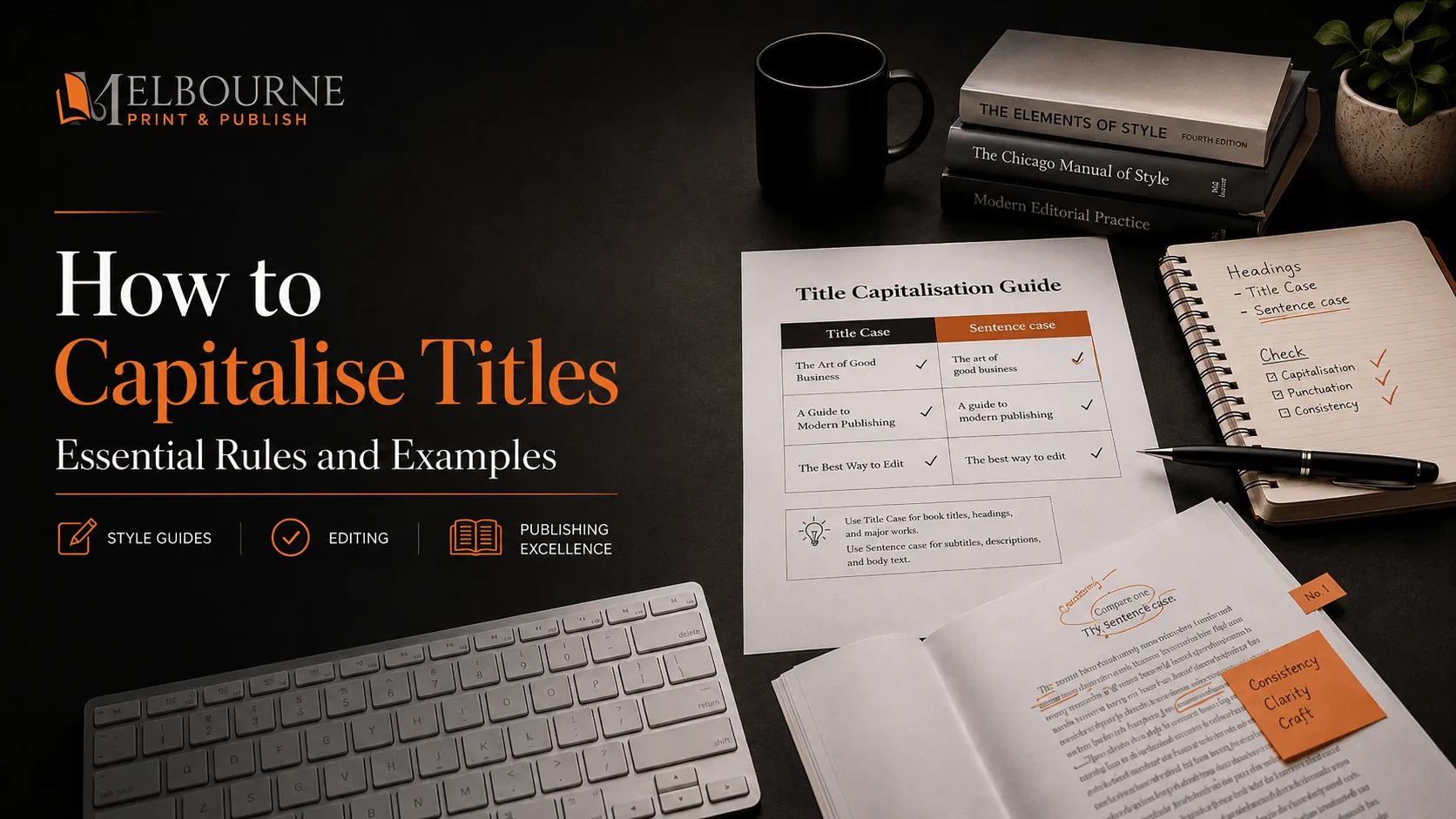
Which words do you capitalise in a title? Learn the AP, Chicago, APA and MLA rules, then format any heading with confidence using this clear, full guide.....

Discover magical realism through a clear diagnostic framework. Learn its key traits, narrative techniques, and how to identify it across global fiction.....
Think about the last time a story genuinely stunned you. The moment a reveal landed so cleanly that you sat back and thought, how did I not see that coming?....