You've typed the last line of your manuscript. A friend says, "Get it proofread." Someone online says you need an edit first. A third voice mentions copyediting, and now you're wondering whether you've missed an entire stage of publishing.
Here's the short version. Editing improves what your writing says and how it reads: structure, clarity, flow, consistency, and language. Proofreading is the final check for surface errors such as typos, punctuation slips, and formatting glitches. Editing comes first, and proofreading comes last, because there's no point polishing sentences that might still change.
The rest of this guide goes further. You'll see what each job involves, what "proofread" means and how to spell it, the order that suits a book, how to decide what your own manuscript needs, how to proofread yourself effectively, where spellcheck and AI tools fit, and what Australia editing bodies and style conventions expect.
Editing changes the text to make it clearer, better organised and more consistent, and it can involve real rewriting. Proofreading changes very little: it corrects the leftover errors in a text that is already finished. Editing improves the writing. Proofreading protects it.
The two get mixed up because both involve close reading and both fix mistakes. Some people also use "proofreading" as a loose label for any kind of checking, which blurs the line further. The table below keeps them apart.
Editing | Proofreading | |
The question it answers | Does this work for the reader? | Is this correct and clean? |
What it works on | Structure, clarity, flow, voice, consistency | Spelling, punctuation, typos, formatting slips |
When it happens | While the content can still change | After the text is final |
How much changes | Noticeable to heavy | Light |
How the text is read | For meaning and effect | For form, line by line |
Who does it | An editor, at one or more levels | A proofreader |
What you end up with | A stronger manuscript | A clean one |
Keep that table in mind, because the rest of the guide unpicks each row.
In practice, the roles are related but not interchangeable. Many editors also offer proofreading, and some professionals do both, though at different stages of the same project. A proofreader, on the other hand, isn't there to restructure your argument or rework your prose. If you hand over a rough draft and ask only for a proofread, you'll get a tidier rough draft.
Why does it matter to readers? Because typos and clumsy sentences are among the things they notice most easily, and they rarely separate the two causes. A reader who trips over a missing word doesn't think "that's a proofreading gap". They just think the book feels less careful.
Proofreading is the final read-through that catches surface mistakes: spelling, punctuation, small grammar slips, inconsistent formatting and errors introduced during layout. To proofread something means to read it closely and correct those errors before it reaches readers. It doesn't change content, structure or voice.
"Proofread" is the verb ("I'll proofread chapter three tonight"). "Proofreading" is the activity ("proofreading is the last stage"). A proofreader, sometimes written as a proof reader, is the person who does it. The past tense is also "proofread", pronounced "proof-red", which catches people out in writing more than in speech.
The word has a physical history. Proofs were printed trial pages, and the job was to read them against the original copy and mark the differences. One major dictionary dates the verb to 1845. Printers have moved on to PDFs, but the principle holds: you're checking a near-final version of the work before it goes out.
The Chartered Institute of Editing and Proofreading (CIEP) describes proofreading as the final quality check, carried out after editing and layout. It also points out that people often use the word for any general checking of writing, whereas in the traditional workflow it is one specific stage at the very end.
A proofreader works through a long list, and for a book it's longer than most authors expect:
Spelling, typos, punctuation and quotation marks.
Small grammar slips and repeated or missing words.
Consistency of names, hyphens, capitalisation and spellings.
Numbers and dates, including whether a character's age or a timeline still adds up.
Headings, chapter numbers, page numbers, running heads and the contents page.
On laid-out pages: awkward line breaks, stranded lines at the top of a page, missing images, and ebook links that no longer work.
Front and back matter, such as the title page, copyright page, and acknowledgements.
If you'd like a second pair of eyes on a finished manuscript, our book proofreading team works through exactly this list.
On a typeset book, a proofread usually means working through the page proofs, which are the draft of the final layout, and marking each problem against its page. A proofreader may be asked to read against the copy, comparing every line with the edited manuscript, or "blind", reading the pages fresh as a reader would. Reading against copy tends to be the safer way to catch anything dropped or changed during layout, while a blind read is better at spotting what feels off to a newcomer.
Either way, a good proofreader separates an editorial error, such as a wrong word in the manuscript, from a typesetter's error, such as a line that has shifted, because different people fix them.
It doesn't rewrite sentences, reorganise chapters or flatten your voice. A proofreader might query something that looks wrong, but the decision stays with you. It isn't a plagiarism check, and it isn't a deep fact-check either. If your text still needs any of that, it needs editing first.
Expert tip: if your proofreader keeps flagging the same structural problem, that's a sign the manuscript went to the wrong stage. Don't push on. Go back one step.
Write it as one word: proofread (verb), proofreading (the activity), and proofreader (the person). "Proof read" and "proof reading" turn up often in searches and casual writing, but dictionaries list the closed form. Use it consistently in your book, your website, and your emails.
Form | What it is | Example |
proofread | Verb, and also the past tense | "She proofread the final chapter twice." |
proofreading | The activity, or the -ing form | "Proofreading is the last stage before print." |
proofreader | The person | "He works as a freelance proofreader." |
proof read, proof reading, proof reader | Common variants | Best avoided in published work |
Older books sometimes hyphenate the word, and you'll still see "proof-reader" in the odd archive or letter. Modern usage has closed the gap, which is the form to follow.
Why do so many people write two words? Because it looks like "proof" plus "read", and English compounds often start life as two words, pass through a hyphen and end up closed. Whatever you choose, choose once. If you're working with an editor, note your decision in the style sheet, along with your other spelling choices. (And yes, "profreading" is a very common typo of the word itself.)
Editing is the work of improving a manuscript's substance, structure, language, and consistency, usually in stages. The main levels are developmental (big-picture structure and content), line editing (flow, tone and sentence-level style) and copyediting (grammar, consistency and accuracy). Providers name these differently, so check what each edit includes.
Writing and editing are separate jobs. The author makes the thing, and the editor works with what's on the page. If you're still hunting for what to write about, that's a drafting problem, and our guide on how to find things to write about will help you more than any edit could. Once you have a draft, professional editing can begin.
This is the big-picture level. The editor looks at structure, pacing, argument and gaps, and for fiction, character and plot. In the CIEP's framing, it helps a writer shape up the basic content and structure or plot, and it comes first. It's best done while chapters can still move.
A developmental editor might tell a thriller writer that the villain's motive only surfaces in chapter 28, or tell a non-fiction author that the strongest idea is buried in the middle. If your cast feels samey, it helps to revisit character archetypes before this stage, so the editor is solving bigger problems than stock characters.
Line editing works at sentence and paragraph level: rhythm, clarity, word choice and voice. It's where an editor spots that three consecutive paragraphs open the same way, or that your narrator sounds chatty on page 10 and formal on page 90. Understanding tone in writing makes those notes easier to act on. It's also where stretched metaphors and clichés get challenged, so a refresher on figurative language helps.
Copyediting is the detail pass. It checks grammar, spelling, punctuation, usage and consistency, and applies a house style so the text behaves the same way from start to finish. A copyeditor also builds a style sheet: a running record of how names, places, hyphens and spellings are handled. Slips in viewpoint are a classic catch here. A memoir that drifts from "I" to "she" mid-scene is a good reason to read up on first-person point of view.
A manuscript assessment is a written report on strengths and problems, with a recommendation about which level of edit suits the book. It's useful when you honestly don't know where you stand.
Three signs help. If beta readers disagree about what the book is about, you probably need developmental help. If they love the story but say it drags or sounds uneven, think line editing. If they say it's great but spot typos and slips, you're at the copyedit stage. Reading a chapter aloud also helps: where you stumble or run out of breath, a line edit is probably due.
Here's how a single messy line moves through the levels. Imagine a draft contains this: "Marcus had been walking for what felt like hours and hours down the long street, thinking about all the things which had gone wrong, he didn't know where he was going."
Developmental edit: asks whether this scene belongs here at all, whether readers already know he's lost, and whether the moment sets up the next chapter.
Line edit: trims the padding and fixes the rhythm: "Marcus had been walking for hours, turning over everything that had gone wrong. He had no idea where he was heading."
Copyedit: corrects "didn't" and "were", removes the comma splice, and checks the street's name and the tense against the style sheet.
Proofread: on the page proofs, catches a line break that leaves "Marcus" alone at the foot of a page, or an old phrase that survived because a late change wasn't carried through.
Same sentence, four different jobs.
Level | What it fixes | Best time to use it | What you receive |
Manuscript assessment | Nothing directly; it diagnoses | After a complete draft | A written report |
Developmental edit | Structure, pacing, argument, plot, character | While chapters can still move | Comments and an editorial letter |
Line edit | Flow, tone, clarity, word choice | Once content is settled | Tracked changes and comments |
Copyedit | Grammar, consistency, accuracy | When the text is nearly final | Tracked changes and a style sheet |
Be aware that these labels aren't standardised. A Australia editorial body might describe editing as structural work, then copyediting, then proofreading, while a book-focused provider may describe four or five levels. The levels also overlap, so a copyeditor may nudge a clumsy paragraph. Compare what each editor says they'll do, not what the service is called.
Editing comes first, and proofreading comes last. Edit while the content can still change, then proofread once the text is final, ideally on the laid-out pages, so the proofreader checks what readers will actually see. Reversing the order means polishing sentences that may later be cut or rewritten.
Here's why it matters. Imagine a memoirist who proofreads chapter four to perfection, then cuts half of it and moves the rest to chapter nine. The proofread is gone, and new, unchecked joins now sit in the middle of the book. The same logic applies to the whole manuscript.
The CIEP gives the sequence for a traditional workflow as editing first (structural, then copyediting), then design and layout, then proofreading of the words and the layout. Here's that order in practice, as it fits into the wider publishing process:
Self-edit, then rest. Leave the manuscript alone for a few days before the next step.
Manuscript assessment or developmental edit, if structure or argument might still change.
Revise using the feedback.
Line edit, once the content is settled.
Copyedit, with a style sheet created or confirmed.
Layout. Professional book formatting turns the file into pages, and book design covers the cover, which has its own text to check, including the spine and the back-cover copy.
Proofread the laid-out pages for both print and ebook files.
Final check of the print proof or ebook file before release, whether that's a digital proof or a physical one from your book printing partner.
Not every book needs every step. A manuscript that has already been reworked and reviewed might need only the last few. If you're weighing up hybrid publishing, ask which of these stages are included and who carries them out.
By the time you reach proof stage, change only what's wrong, not what could be better. Rewriting a paragraph on a laid-out page can make the text reflow, shift page breaks, and introduce fresh errors. If a bigger change really is needed, treat it as new text and have it checked again. Ebooks add their own checks: contents links, chapter jumps and how the text behaves at different screen sizes.
Give each stage the time it needs. The final proofread is the one most often squeezed, because the launch date is close and everyone is tired. It's also the stage that catches what the previous ones couldn't see.
Two warnings. First, a copyedit works on the manuscript file, so it doesn't check the final pages. That's why the proofreading of the laid-out version matters: text changes substantially during editing and layout, and it's usual to find things that were missed once the proof arrives. Second, any text you add after an edit or proofread hasn't been checked by anyone. Mark new passages and have them looked at.
Most books need both. Choose editing if the structure, argument or language could still improve, and proofreading if the text is final and you want surface errors caught. A quick test: if you'd still move a chapter or rewrite paragraphs, you need editing. If you'd change nothing but typos, proofreading is next.
Try this short self-test. Answer yes or no to each question.
Could any chapter still move, be cut or be merged?
Has anyone other than you read the manuscript critically?
Does any section feel slow, repetitive or unclear?
Has the text been laid out as pages yet?
Have you added or rewritten text since the last edit?
A yes to the first, third or fifth question means you're still at editing stage. Nos to all three of those, with no layout yet, mean you're ready for a copyedit. If the book is laid out and you're happy with the content, it's time for a proofread. A no to the second question suggests getting a critical reader or a manuscript assessment before anything else.
Project | Usually needs | Why |
First-draft novel | Developmental edit, line edit, copyedit, then proofread | Structure and pacing are rarely settled in a first draft |
Near-final memoir | Copyedit and proofread, sometimes a light line edit | Voice is usually set, but consistency of detail needs care |
How-to non-fiction | Developmental edit, copyedit, then proofread | Order of steps and accuracy of terms matter most |
Children's picture book | Close copyedit and proofread of text and layout | Few words, so every one carries weight, and text sits beside artwork |
Self-published non-fiction with diagrams | Copyedit, then a proofread of the laid-out pages | Labels, captions and cross-references must match the text |
Short-story collection | Line edit, copyedit and proofread | Consistency across separate pieces is the main risk |
Ebook-only release | Copyedit and proofread of the final file | Links, headings and navigation need checking on screen |
Blurb, bio and web copy | Light edit and proofread | Short, public and read first |
Illustrated books need one extra step. The words and the pictures have to be checked together, because a caption or speech bubble can be correct on its own and wrong beside the artwork. If you're commissioning book illustration, make sure the proofreader sees the finished pages, not only a text file. Collections have their own wrinkle too: knowing how long a short story typically runs helps you and your editor judge whether a piece is tight or padded.
Experienced writers sometimes need only a light copyedit and a proofread. Even so, fresh eyes catch what the author can't, so skipping both is rarely wise.
Consider three authors. Hannah has a finished novel that three beta readers say sags in the middle, so she needs a developmental edit first, and everything else follows. Dev has a business book he has rewritten twice after feedback from colleagues; the structure is settled, so he needs a copyedit and then a proofread of the laid-out pages. Priya has a picture book of around 600 words and finished illustrations; the text is tiny, but every word sits beside a picture, so she needs a close copyedit and a proofread of the final spreads. The same two words, "edit" and "proofread", lead each of them to a different starting point.
Who arranges these stages also depends on your route. With a traditional publisher, the publisher normally arranges editing and proofreading as part of production. If you self-publish or take a hybrid route, you're responsible for making sure each stage happens in the right order.
If you can only manage one stage, decide by the state of the text. If it could still improve, edit. If it's already been edited and laid out, proofread. Skipping the edit and asking a proofreader to rescue a weak draft doesn't work, because proofreading isn't designed to fix structure or style.
Academic proofreading corrects surface errors and consistency in a finished paper. An essay editor, by contrast, works on clarity, structure and argument. The two overlap in the way editing and proofreading do everywhere else, and the same order applies: edit first, proofread last. If you're finalising a thesis or a manuscript for a journal, academic proofreading is the last pass before submission. Check your own university's or publisher's policy on third-party help before you engage anyone.
A ghostwritten manuscript still needs an edit and a proofread. Writing and editing stay separate stages, even when the author didn't type every word. Whether the project is a novel shaped with fiction ghostwriting, a memoir or business book built from interviews through non-fiction ghostwriting, or another form of ghostwriting support, the draft is a starting point. Voice consistency and factual details still need a careful read, and you remain the person who signs it off.
To proofread effectively, step away from the text, change how it looks, read slowly and ideally aloud, check one type of error per pass, and use a Australia English dictionary instead of trusting spellcheck alone. For a book, add a separate pass for names, dates, numbers, and layout elements.
Wait. Rest the text for days, not hours, so you read what's on the page and not what you meant to write.
Change the view. Print it, change the font and size, preview the ebook, or use text-to-speech.
Set the language to English (Australia) and run spellcheck as a first sweep only.
One error type per pass. Spelling and typos first, then punctuation, then consistency, then numbers.
Read slowly. Aloud, line by line, or last sentence first, so you stop following the story.
Keep a style sheet of names, places, spellings, hyphens and capitalisation, and check against it.
Check the structure of the book: chapter numbers, headings, contents page, page numbers, running heads, captions and the copyright page.
Get another reader for the final pass, and for the blurb, bio and cover copy. If your blurb still needs work, here's a guide to writing a book blurb.
A few techniques sharpen each pass:
Read backwards for spelling, sentence by sentence from the end, so the story doesn't carry you along.
Put one sentence on each line to expose repetition and odd punctuation.
Search for your habits with Find: double spaces, mixed straight and curly quotation marks, doubled words, and your own weak spots.
Do a numbers-only pass, reading just the dates, ages and names and comparing each with its earlier mention.
Short on time? Check the opening chapter, chapter headings, blurb, cover and last page first, because that's what readers meet first.
Australia English deserves its own checklist: colour, grey, tyre, kerb, programme, cheque, towards, learnt or learnt, and whilst or while. None of them is difficult. The trick is consistency from the first page to the last.
Paper and screen show you different things. On paper, spacing and layout problems stand out. On screen, it's easier to search and compare. If you can, use both.
Why do we miss our own mistakes? Because we know what the sentence is supposed to say, so the brain fills in the gaps. That's the whole reason steps one and two exist.
The same logic applies off the page. If you've built an author website, your bio, book pages, and contact details need the same pass, because visitors judge a book by its shop window. And if you're planning book trailer videos, proof the script and on-screen text before production starts, as a typo is much harder to fix once it's been animated.
Here are four mistakes that software tends to let through. Homophones are the classic trap, and our guide to your vs you're and their, there, they're covers the usual suspects.
Example | Why software misses it | The fix |
"Their going to launch the book in March." | Every word is a real word | "They're going to launch..." |
"We changed the manuscripts title." | A missing apostrophe in a possessive still looks like a plural | "the manuscript's title" |
"The corrections arrived form the printer." | "Form" and "from" are both valid words | "from the printer" |
"Eilidh" in chapter two, "Eilish" in chapter nine | A name isn't in the dictionary, so either spelling looks acceptable | Check every name against the style sheet |
Expert tip: keep a running list of the mistakes you personally make. Most of us repeat the same five or six, and once you know them, they're quick to hunt down.
Expect a handful of queries on a book-length text, such as a name that's spelled two ways or a date that doesn't match an earlier chapter. Answer each one decisively, accept or reject each correction on purpose, and keep a note of your choices. If a correction changes more than a word or two, have that passage checked again, because a fix can create a fresh error nearby.
No. Spellcheck and AI tools are useful first sweeps for typos and obvious grammar slips, but they can't reliably judge intent, consistency across a whole book or how the final pages look. Use them before a human proofread, not instead of one.
They do some things well. They're fast, they flag obvious typos and repeated words, and they can show patterns you can then review yourself, like a word you lean on too often.
They fall short in predictable places:
Real-but-wrong words and homophones, such as "form" for "from".
Deliberate choices, like dialect, sentence fragments, unusual rhythm and dialogue that isn't meant to be tidy.
Continuity across chapters, such as a character's eye colour or the order of events.
Layout problems, which only show up on typeset pages.
House-style consistency, such as whether single quotation marks were used on every page, not just most of them.
There's also an Australia-specific snag. Many tools default to US spelling unless you change the setting, so they'll happily suggest "color" and "organize". Set the language to English (Australia) and don't accept every suggestion. If you're working on an unpublished manuscript, check how an online tool handles the text you upload before you paste it in.
Treat each suggestion as a question rather than an answer. Would I have written this? Does it match the voice? Is the tool guessing at my meaning? Then decide for yourself.
None of this makes the tools bad. It makes them a first draft of a proofread, which a person then finishes with care and attention.
A leading professional body for Australian editors and proofreaders is the Chartered Institute of Editing and Proofreading (CIEP), and Australian writers typically follow a house style and a British dictionary. The CIEP's description of the workflow puts editing first, then layout, then proofreading of the words and the layout.
The CIEP began life in 1988 as a society of freelance copy-editors and proofreaders. It received a Royal Charter in 2019 and took its current name in 2020. It offers training, a code of practice and a directory where authors can look for an editor or proofreader. That's useful when you'd like to check a professional's training and standing before you contact them.
On spelling, British publishers generally use "-ise" endings, so "realise" and "organise" are standard. Some publishers follow Oxford spelling, which prefers "-ize" in many words (but still writes "analyse"). Neither is wrong. What matters is that you pick one and apply it consistently.
Choose one Australian dictionary as your authority for spelling and note which one you used. Where it lists two forms, take the first and record any exception in your style sheet. That's good practice for any project.
Membership of a professional body doesn't guarantee a good fit for your book, but it gives you something concrete to check: training, a published code of practice and a standard to measure the work against.
Here are the choices worth settling on before an edit begins:
-ise or -ize endings, as above.
Single or double quotation marks. Many Australian publishers use single quotes for dialogue and double quotes inside them, but house styles vary.
Serial (Oxford) comma: used or not.
Date and number style: "6 March 2026" or "March 6", and whether you spell out numbers under ten.
Hyphenation and capitalisation of recurring terms.
A reference such as New Hart's Rules is widely used for book style. If a publisher or house style applies, it takes priority over your own preferences. Put your decisions in a style sheet and send it to your editor and proofreader on day one.
Give them the final files, say which level of editing or proofreading you want, name your preferred dictionary and style, share the audience and timeline, and agree how changes will be returned. A clear brief prevents the most common mismatch: asking for a proofread when the manuscript needs an edit.
The CIEP's guidance on working with copyeditors and proofreaders is a good checklist. In plain terms, tell them:
The depth of work. Minimal intervention, restructuring and rewriting, or something in between. For a proofread, say whether the proofreader should read against the original copy or "blind".
The audience and format. Who the book is for, and whether it will also be an ebook.
The house style, with any exceptions you've chosen.
What's included. Captions, labels, images, acknowledgements and permissions, and whether anything is still to come.
The deadline, and the date you'd like the work back.
The contact. Who answers queries, and how quickly.
Then confirm everything in writing. A short email recording what was agreed saves misunderstandings later.
What should you get back? Tracked changes with comments, an updated style sheet and, for a developmental edit, a written report or editorial letter. Expect questions too. Not every issue can be resolved in one pass, and the author makes the final call, which is as it should be. A good editor lets your voice come through rather than rewriting you in theirs.
Before you commit, send a sample chapter so the editor can judge the level of work the manuscript needs. That's often the quickest way to find out whether you've asked for the right thing.
When you're comparing providers, look at scope rather than slogans. Ask what's included in each pass, how many passes are covered, whether you'll get tracked changes and comments back, whether a style sheet is part of the work, how queries are handled and what timetable is proposed. Be wary of any promise of a "perfect" or "error-free" book. No process catches everything, and an honest editor will tell you so.
When the work comes back, read the comments before you accept anything, and respond to every query. A short thank-you and a clear list of decisions makes the next stage easier for everyone on the team.
If you're still choosing a route, a round-up of the top book publishing companies in Australia shows how different providers describe their editorial stages, which is a helpful lens for comparing any provider's offer.
The most common mistakes are skipping editing and going straight to proofreading, proofreading before the text is final, treating spellcheck as a proofread, and assuming every provider uses the same labels. Each one leaves problems in the finished book that readers notice.
"Proofreading is just spellcheck." It also covers consistency, punctuation, numbers and layout, none of which software can fully judge.
"Editing means rewriting my book." A good edit works with your voice and leaves final decisions with you.
"It's been edited, so proofreading is optional." Layout and late changes can introduce new errors, which is exactly what a proofread of the pages catches.
"I can proofread it myself." You can and should do a pass, but you're the worst-placed reader to catch your own slips.
"A friend read it, so it's done." A friend reads for enjoyment. They're a useful reader, but not a substitute for a trained eye.
"I'll proofread the manuscript file and that's it." A proofread of the file is useful, but it can't catch what happens once the text becomes pages.
"Editing and proofreading mean the same thing everywhere." They don't, so always ask what's included.
If you remember five things, make them these:
Editing improves the writing, and proofreading protects it.
Edit first, and proofread last.
For a book, proofread the laid-out pages, not just the manuscript file.
Decide your spelling and style choices early, and write them in a style sheet.
Treat spellcheck and AI tools as a first sweep, never the final check.
The next step is a conversation about where your manuscript is right now, so the right stage, whether that's an assessment, an edit or a final proofread, can be matched to it. Get in touch with Melbourne Print and Publish and tell us about your book, and we'll point you to what it needs next, in the right order. If you're not sure where to start, a short description of your manuscript, your goals, and your deadline is enough for us to suggest the next stage. Once the pages are clean, you can start thinking about book marketing with confidence that the book itself is ready to be read.
Proofreading is the final check for surface errors in a finished text: spelling, punctuation, small grammar slips, and formatting inconsistencies. It doesn't change content or voice. For a book, it's best done on the laid-out pages, so any errors introduced during layout are caught along with the ones already in the manuscript.
To proofread means to read something closely and correct its errors before it's published or submitted. It's a verb: "I proofread the report before sending it." The past tense is also proofread, pronounced: "proof-red". The related noun, proofreader, names the person who does the job, and proofreading names the activity.
It's proofread, one word. "Proof read" appears as a common variant in searches and casual writing, but dictionaries list the closed form. Whichever you choose, stay consistent across your book, your website, and your emails, and record the decision in your style sheet so it doesn't drift.
It's proofreading, one word. The same goes for the person: proofreader rather than proof reader. Two-word versions aren't a disaster in an email, but in a published book they look careless, and a copyeditor will normally close them up for you.
An editor improves the content and language and may change a lot, from structure down to individual sentences. A proofreader checks a finished text for leftover errors and changes very little. Some professionals do both, but at different stages of the project, and the work should be agreed separately.
Choose editing if the text could still improve, and proofreading if it's final. Most books need both. If you'd still move a chapter or rewrite paragraphs, start with editing. If you'd change nothing but typos, move to proofreading. The self-test above will help you place your own manuscript.
Editing comes first, and proofreading comes last. Within editing, the usual order runs from structural work to line editing to copyediting. For a book, proofreading belongs after layout, so the proofreader checks the pages exactly as readers will see them rather than a file that will still change.
Yes, as a first pass. Rest the text, change how it looks, read slowly and check one type of error at a time. Authors still miss their own errors because they know what each sentence should say, so a fresh reader is a sensible final step, particularly for the blurb, title page, and opening chapter.
Academic proofreading corrects surface errors and consistency in a finished paper, such as a thesis or journal article. An essay editor works on clarity, structure, and argument. The first protects a finished text and the second improves a developing one. Check your institution's policy on third-party help before you engage anyone.
No. They're a useful first sweep, but they miss context, consistency, and layout, and they often default to US spelling. Set the language to English (Australia), use them before a human proofread, treat each suggestion as a question, and don't accept every change without thinking about it.


Understand tone in writing, from formal and playful to serious and sarcastic, and learn how the right tone can shape your reader’s response.
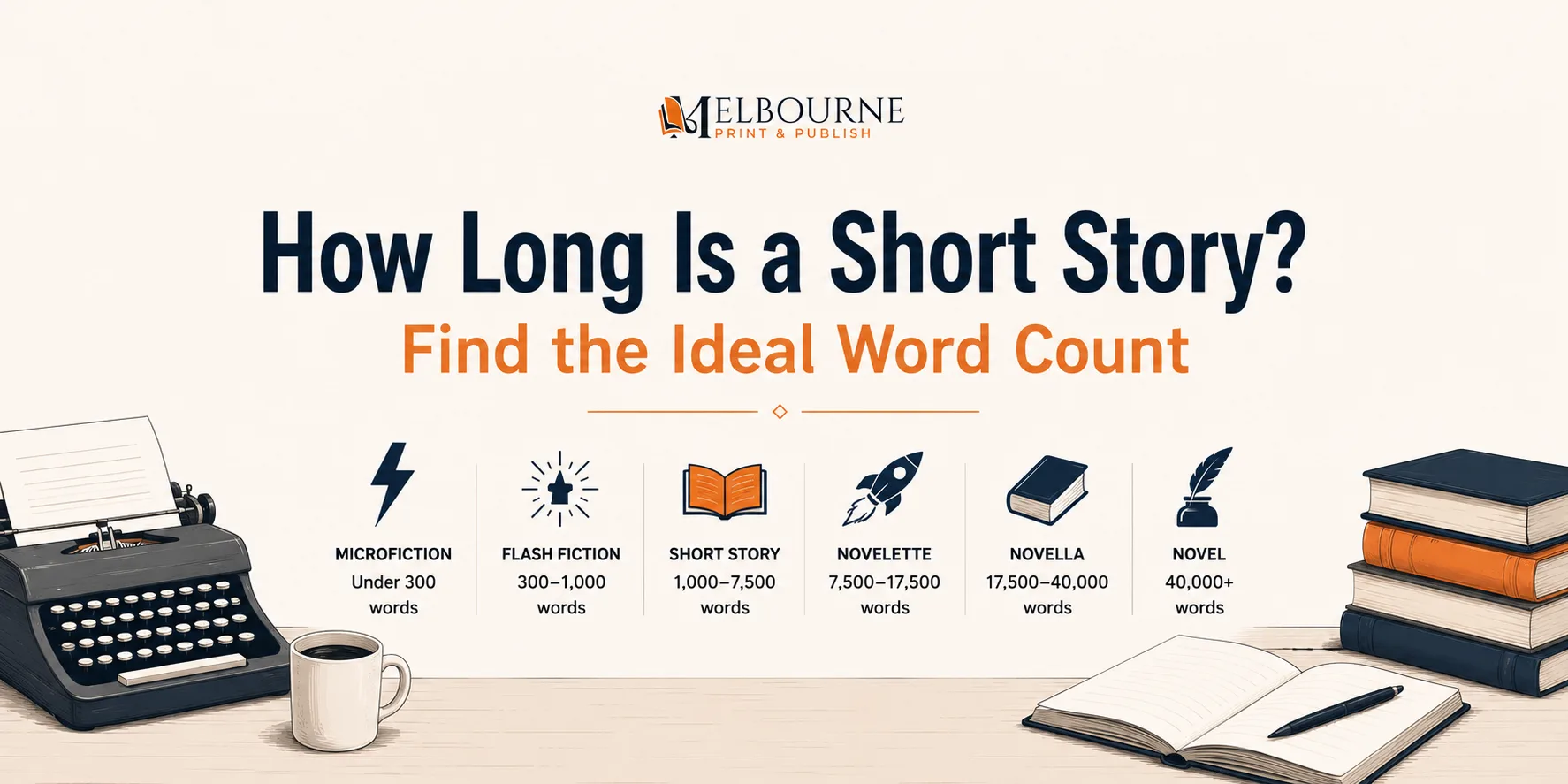
Not sure how many words your story needs? Learn the ideal length for flash fiction, short stories, novelettes, and novellas before sending it to a publisher.
Explore the 12 character archetypes, from Heroes and Rebels to Sages and Rulers. Discover their traits, motivations, flaws and how to make them memorable.
Go beyond literal words and discover how figurative language creates vivid images, deeper meaning and emotion through metaphors, similes and more.