You've just typed the last line of your short story. It's tight. It's sharp. It's ready. Then the doubt creeps in. Is it too short? Too long? Will an editor even get past the first page? You're not alone. Word count confusion sends more good stories into the rejection pile than bad writing ever does.
Search online, and you'll find a dozen different answers. One site says a short story is 1,000 to 7,500 words. Another says up to 10,000. A contest caps entries at 3,000. A magazine wants 5,000. And where do flash fiction, novelettes, and novellas fit into all this?
This guide cuts through it. We've checked the current rules from the SFWA, the Hugo Awards, the major literary magazines, and Australia's own leading short fiction prizes, so you're working from one reliable reference instead of ten conflicting ones. By the end, you'll know exactly where your story sits, which markets want work at that length, and how to trim or expand a draft without losing what makes it work.
A quick note before we get into it: a lot of the "definitive" word count guides floating around repeat the same handful of errors, uncritically, from each other. A few of those errors are corrected in this guide, including one about the Pushcart Prize and one about how short-read categories actually work. Both are worth knowing before you rely on them for a submission decision.
Let's start with what a short story actually is.
A short story is a focused piece of fiction built around a single incident, character, or emotional shift, designed to be read in one sitting. It doesn't have room for subplots or a slow-build backstory. Every sentence has to earn its place.
Think of a novel as a long embrace. A short story is a punch.
Expert Tip: Aim for one powerful emotional effect rather than a complex, multi-thread plot. If your story is trying to do the work of three storylines, it's probably a novel wearing a short story's clothes. If that's the case, our guide to how many words are in a novel will help you plan for the bigger canvas.
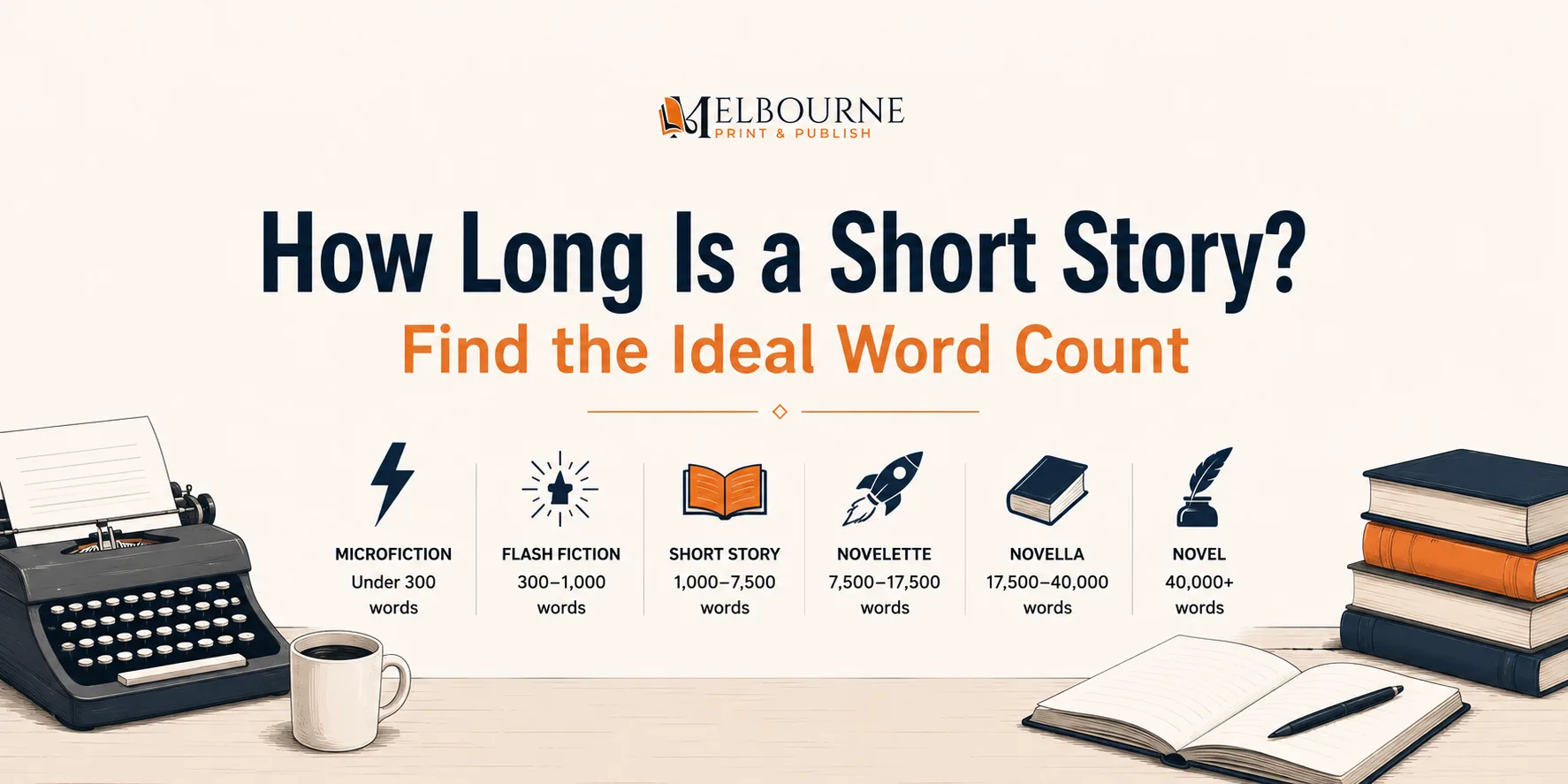
Here's how the short story sits against its neighbours:
• Microfiction — under 300 words, sometimes as short as six.
• Flash fiction — roughly 300 to 1,000 words, a complete arc in miniature.
• Short story — 1,000 to 7,500 words, the workhorse length for literary magazines and most contests.
• Novelette — 7,500 to 17,500 words, common in genre fiction but rare outside it.
• Novella — 17,500 to 40,000 words, room to breathe without the scope of a full novel.
• Novel — 40,000-plus words (commercial publishers generally treat 50,000 as the practical floor).
These aren't laws. They're conventions, mostly inherited from the science fiction and fantasy award world, that the rest of publishing has quietly adopted because nobody had a better system. Keep that in mind before you panic over being 200 words outside a boundary.
It's also worth separating two different questions that writers often blur together: "what length is my story?" and "what length should my story be?" The first is arithmetic. The second is a craft decision, and it comes down to how much story you actually have. A single argument between two people over one evening doesn't need 12,000 words to land. A multi-generational family secret probably won't fit in 2,000. Count your draft first, but don't force it toward a category if the story genuinely wants to be a different length. Editors can tell the difference between a story that's the right length and one that's been stretched or squeezed to hit a number.
Use this table to work out where your draft sits, then check the "Typical Markets" column for where to send it.
Form | Word Count | A Well-Known Example | Typical Markets & Awards |
Microfiction | Under 300 | "For sale: baby shoes, never worn" (six-word story, often misattributed to Hemingway) | Microfiction journals, very-short-story publications, social-media flash contests |
Flash Fiction | 300–1,000 | "Sticks" by George Saunders | Flash-fiction journals and flash-fiction awards |
Short Story | 1,000–7,500 | "The Lottery" by Shirley Jackson (around 3,800 words) | Literary magazines and major short-story prizes |
Novelette | 7,500–17,500 | "The Strange Case of Dr Jekyll and Mr Hyde" by Robert Louis Stevenson | Genre-fiction magazines and major speculative-fiction awards |
Novella | 17,500–40,000 | "The Metamorphosis" by Franz Kafka (around 21,000 words in most English translations) | Dedicated novella publishers and major novella awards |
A quick note on those famous examples: word counts shift slightly between editions and translations, so treat the figures above as close estimates rather than a fixed tally.
Here's where a lot of the confusion actually starts. Different organisations measure "short story" differently, and if you don't check which one applies to your submission, you can find yourself in the wrong category before a judge even opens the file.
The Science Fiction and Fantasy Writers Association sets the benchmark most of publishing quietly borrows from. For Nebula Award eligibility:
• Short story: under 7,500 words
• Novelette: 7,500 to 17,499 words
• Novella: 17,500 to 39,999 words
• Novel: 40,000 words or more
These boundaries are hard lines. SFWA doesn't have a grace margin, so a 7,510-word piece is a novelette for their purposes, full stop.
Here's a detail that trips a lot of writers up: the Hugo Awards, run by the World Science Fiction Society, use exactly the same numbers as SFWA, 7,500, 17,500, and 40,000. The two aren't actually in conflict, despite what a lot of "definitive" guides claim.
Where the Hugos genuinely differ is flexibility. Under the WSFS Constitution, administrators can move a story into a more fitting category if its length sits within 20% of the boundary. So a 44,000-word piece can, at the judges' discretion, still be entered as a novella. SFWA's rules don't offer that same wiggle room.
Most literary magazines don't publish a strict definition of "short story." They publish a submission cap instead, and that number tells you far more than any dictionary entry does.
• Some major literary magazines rarely run fiction over 8,000 words.
• Some of Australia's oldest literary magazines don't state an upper word limit for prose, though most published stories fall well under 5,000 words.
• Other Australian literary journals likewise set no fixed ceiling, though editors are naturally selective about length.
• Major themed quarterly publications build each issue around a mix of essays, memoir, and short fiction, with individual story lengths varying by theme.
A pattern worth noticing: Australia's major literary journals rarely publish a hard upper limit the way American genre magazines do. That's not an invitation to submit something enormous. It's a signal that these editors are judging length by feel and fit within the issue, not by a rule, so a story that's the right length for its content will read as "right" regardless of the exact figure. When in doubt, look at a recent issue rather than a submissions page.
Expert Tip: The sweet spot for most literary magazines, Australian and international, sits between 2,000 and 5,000 words. Always check the specific publication's current guidelines before you finalise anything, since these change more often than writers expect.
Contests tend to be stricter than magazines, and the limits vary widely:
• The ABR Elizabeth Jolley Short Story Prize, one of Australia's richest short fiction awards at A$12,500 total, accepts entries between 2,000 and 5,000 words.
• The BBC National Short Story Award accepts entries up to 8,000 words, with a £15,000 first prize.
• Many regional and small-press competitions cap entries at 2,000 or 3,000 words.
One correction worth flagging here: you'll see the Pushcart Prize listed all over the internet with a "5,000-word limit." That's a myth. The Pushcart Prize isn't a submissions contest at all; writers can't enter it directly. Small press and magazine editors nominate up to six pieces of already-published work each year, in any genre and at any length, and a panel selects the winners from those nominations. There's no word cap because there's nothing to submit in the first place.
Word count conventions shift depending on what you're writing. A horror editor and a science fiction editor are looking for very different things at very different lengths.
Literary magazines tend to favour 2,000 to 5,000 words, though some will run pieces up to 7,500. These stories usually lean on character and language rather than plot mechanics, so a slightly longer runtime is easier to justify if the prose earns it. Kristen Roupenian's "Cat Person" runs to roughly 7,000 words, long by literary-magazine standards, but it worked because every scene was doing real character work. If you're leaning into the kind of tonal reversals that make literary fiction sing, our piece on types of irony in literature is worth a look.
SF/F markets are the most flexible of the genre spaces. Leading genre publications regularly publish anywhere from 1,000 to 20,000 words, and worldbuilding often demands the extra room. Ken Liu's "The Paper Menagerie" sits at roughly 4,500 words, while plenty of award-winning novelettes in the genre run 10,000 to 15,000.
Horror rewards brevity. Most published horror short stories sit between 1,500 and 5,000 words, since tension tends to collapse the longer a story stretches. Flash horror, under 1,000 words, does particularly well in online markets. Charlotte Perkins Gilman's "The Yellow Wallpaper," often cited as an early feminist horror classic, runs to around 6,000 words.
Romance short stories generally run 1,000 to 5,000 words, built around a tight emotional arc rather than a sprawling plot. Some anthology markets want pieces as short as 800 to 1,500 words. A typical commercial romance short runs around 3,000.
Mystery short stories usually land between 2,000 and 6,000 words, with a clean plot and a twist that lands on the final page. Poe's "The Murders in the Rue Morgue," often credited as the first modern detective story, runs to roughly 12,000 words, long enough that it would be classed as a novelette by today's definitions, even though it predates the category by a century.
This category runs shorter across the board, since the intended reader's attention span and reading level set the ceiling rather than genre convention. Short fiction for younger primary-age readers often sits under 1,500 words, while YA short stories aimed at teenagers can run closer to standard adult short story length, 2,000 to 5,000 words, especially in themed anthologies built around a single issue or experience. Educational and school-market anthologies in Australia tend to specify length tightly, since they're often built around a fixed page count per contributor.
Expert Tip: If you're unsure what a market actually wants, skip the submission guidelines for a minute and count the words in three or four stories they've published recently. The real preference is often narrower than the stated one.
This sounds like a formality until it costs you a submission.
Traditional publishing still estimates length using the "250 words per page" convention: double-spaced, 12-point font, one-inch margins. This dates back to the typewriter era, and plenty of agents and editors still use it as a mental shortcut for reading time, even when your word processor gives them an exact figure.
Most modern word processors will give you an exact figure, and most contests and magazines are happy to use it. Some, however, specify the method, so read the fine print before you round anything up or down. When you're formatting your final manuscript for submission, small details matter more than they should; even something like correct title case can be the difference between a polished submission and one that reads as rushed.
Most software counts are more consistent than writers assume, but a few edge cases trip people up. Hyphenated compounds ("well-worn," "twenty-three") typically count as one word, not two. Dialogue tags and punctuation don't add to the count on their own. Title pages, headers, and your name and contact details at the top of a manuscript are generally excluded from the story's word count, even though they appear in the file. If a market asks for "story word count" specifically, that's what they mean, not the total length of the document you're submitting.
If a market doesn't specify a method, use your software's count and round to the nearest hundred. For print submissions, include the word count on your first page using the 250-words-per-page method. And read the whole thing aloud before you send it. It catches pacing problems no word counter ever will.
Every short story writer eventually hits the same wall: the idea is bigger than the form allows, or smaller than the market wants. Here's how to work with that instead of against it.
Start as close to the climax as you can manage. If your first two pages are backstory, cut them and weave what's essential into the action instead. A useful structural shortcut here is the rule of three: three attempts, three images, three beats, which gives a short piece rhythm without needing the space a novel has for repetition.
Expert Tip: Make sure your story has a complete arc. It shouldn't read like an excerpt from something longer. The ending needs to feel earned, not just stopped.
Every scene in a short story needs to do double duty, advance the plot and reveal character at the same time, and leaning on familiar character archetypes can help you do more with less. A 3,000-word story might only have room for two or three scenes total. If you're deciding which characters actually need page time, it helps to be ruthless about who's driving the conflict; our breakdown of protagonist versus antagonist roles is a good sense-check before you cut.
Use summary to cover time jumps instead of dramatising every moment. Not every beat needs a scene.
Cut adverbs and weak adjectives in favour of specific verbs. "He sprinted" beats "he ran quickly" every time. Strip out filter words like "she saw" or "he thought," which quietly put distance between the reader and the moment.
Study writers who work in tight spaces on purpose — Alice Munro, Raymond Carver, George Saunders. Notice what they leave out more than what they include. If your own editing eye needs a second opinion, a professional editing pass can catch the sentences you're too close to see clearly.
If your story is coming in under the mark, look for places where you've summarised an emotional beat instead of dramatising it. Add sensory detail or a moment of reflection there rather than bolting on a subplot that doesn't serve the theme.
Specialist flash-fiction journals and international flash-fiction contests are solid starting points. In Australia, keep an eye on themed calls from smaller online journals, since flash fiction turns around faster than any other form.
Internationally, established literary magazines sit at the top of the literary tier, while dedicated science fiction and fantasy publications lead genre fiction. In Australia, major literary journals and established short-story prizes are important options for serious short fiction writers.
Novelettes are the hardest length to place, too long for most literary magazines, too short to stand alone as a book. Established genre-fiction publications are the most reliable homes, and the Hugo and Nebula Awards for Best Novelette give the form some visibility it wouldn't otherwise get.
Novellas have had a genuine resurgence thanks to digital publishing, where a shorter e-book doesn't carry the same stigma it once did in print. Dedicated novella publishers exist, and both the Hugo and Nebula Awards give the form its own category. On the self-publishing side, short-read categorisation is worth understanding if you're releasing a novella independently.
Here's where a lot of guides get the maths wrong, so it's worth spelling out properly. Short-read categories can sort books by estimated reading time based on page count, not word count directly:
Reading Time | Page Range | Approx. Word Count (at 250 words/page) |
15 minutes | 1–11 pages | Up to ~2,750 |
30 minutes | 12–21 pages | ~2,750–5,250 |
45 minutes | 22–32 pages | ~5,250–8,000 |
One hour | 33–43 pages | ~8,000–10,750 |
90 minutes | 44–64 pages | ~10,750–16,000 |
Two hours or more | 65–100 pages | 16,000+ |
So a 5,000-word short story lands closer to the "30-minute" bracket, not "15 minutes" as some guides claim, and a 15,000-word novelette sits in the "90-minute" range rather than "one hour." Worth checking the maths yourself before you tag your own release, since page-count thresholds can occasionally shift. If you're formatting a novella or story collection for e-book publication, our e-book writing and book formatting services handle exactly this kind of conversion work.
Online publishing platforms carry no strict word limits and can be useful for building an audience before you pitch traditional markets. For anthology opportunities, keep an eye on Australian writers' organisations and open calls tied to specific themes.
Once you've got six or eight short stories that share a theme, a voice, or a thread of character, a different question shows up: should these live as separate submissions, or become a collection?
A collection changes the format entirely. You're no longer thinking in single-story word counts; you're thinking in book length, which typically means somewhere between 40,000 and 80,000 words across all the stories combined, similar territory to a novel. The individual pieces still work as short stories, novelettes, or novellas in their own right, but the interior design, the print run, and the marketing all shift to book-scale decisions. That's a different process from outlining a novel, since you're arranging existing pieces rather than building a single continuous arc, but it borrows some of the same structural thinking around pacing and reader momentum across the whole book.
Interior book design matters more for a collection than most writers expect. Section breaks, ordering, and even the white space between stories all affect how the collection reads as a whole, not just story by story. If you're planning a print run rather than an e-book-only release, book printing services can walk you through run size and cost, which behave very differently for a 60,000-word collection than for a single 5,000-word story sold as a standalone e-book.
Marketing works differently too. A single short story lives or dies on where it's published. A collection needs its own campaign, and something like a short book trailer can do a lot of work for a launch, giving readers a feel for tone and voice across the whole collection rather than just one piece of it.
A tight, powerful 3,000-word story usually beats a bloated 7,000-word one. Editors read for control, not volume. If a piece meanders, length isn't buying it any goodwill.
It isn't. Fitting a complete story into under 1,000 words means every single word has to carry weight, and the ending has to land instantly, with none of the room a longer piece has to build toward it. Try writing a 100-word story once, just to feel how hard the constraint actually is.
Word count ranges are guidelines, not hard rules for the story itself; they mostly exist for award and submission eligibility. A 7,600-word piece can absolutely still function as a short story in every meaningful sense. Focus on whether the story feels complete, not whether it lands on a specific number.
Genre markets are more flexible than literary ones, but they still have real expectations. A 20,000-word horror story is a tough sell as a standalone short piece unless it's positioned and marketed as a novella from the start.
As the Hugo and SFWA comparison above shows, this one's overstated. The two biggest speculative fiction award bodies actually agree on the exact same three thresholds. What varies is discretion, not definition; the Hugos allow administrators some movement near a boundary; SFWA doesn't. Most of the real variation you'll hit comes from individual magazines and contests, not from the major award bodies disagreeing with each other.
Editors consistently describe the same tell: they can sense within the first paragraph whether a writer has control over length. A story that runs long tends to meander. One that's too short tends to feel rushed. The stories that work sit exactly where every scene earns its place, no more, no less.
Published short story authors often describe a similar process: write the first draft without worrying about length at all, then cut roughly 10% in revision. That forced trimming is often what turns a decent draft into a sharp one. Reading the piece aloud is the other trick that comes up again and again: if you stumble over a sentence or get bored partway through, that's the section that needs cutting.
Most literary magazines that pay for fiction do so by the word, often somewhere in the range of 8 to 12 cents per word for professional-tier markets, with some Australian outlets working on a flat per-story or per-page rate instead. A longer story can earn more outright, but it's also a harder sell to a magazine with limited page space.
Some online markets pay a flat fee regardless of length, which quietly makes shorter stories more efficient per word if you're writing partly for income.
Expert Tip: If income matters to your submission strategy, the 3,000 to 5,000 word range tends to balance acceptance odds against payout best. It's long enough to feel substantial, short enough that most markets can still fit it in.
Flash fiction markets have grown fast, driven by mobile reading habits, though competition for the handful of paying slots is intense. Novellas are seeing real demand from digital-first publishers and subscription platforms. Traditional short stories in the 2,000 to 5,000 word range remain the backbone of literary magazine publishing, in Australia and everywhere else.
Self-publishing changes this calculation again. A standalone short story sold as an A$0.99 e-book rarely earns back the time it took to format and list it individually; the economics only start working once you've got a collection or a novella substantial enough to justify an A$2.99 to A$4.99 price point. That's one reason so many short story writers hold individual pieces back for magazine publication first, then bundle them into a paid collection once they've built a small readership through free or low-cost placements.
If you're building toward self-publishing a collection rather than chasing magazine acceptances, the cost side of the equation looks different again; our guide to how much book publishing costs in Australia breaks down what to budget for. And once you've got stories ready to sell, a proper marketing plan and an author website do more for discoverability than word count ever will.
For tracking word count: Most modern writing software lets you set project targets or monitor your word count while you draft.
For editing down: Editing tools can flag dense sentences, passive voice, wordiness, and weak verbs, though no tool replaces reading the piece aloud yourself.
For finding markets: Submission databases can let you filter opportunities by word count, genre, and pay rate, which saves hours of manually checking guidelines. Some also let you set alerts for new listings that match your story's exact length, which is a faster way to find a home for an awkward-length novelette than browsing manually.
For formatting the final draft: Digital book-editing tools can handle standard manuscript formatting and word counts as you write, and some export cleanly if you're preparing something for e-book release. They won't replace a proper formatting pass for print, but they can be a solid starting point for drafting.
If the editing pass turns up more than you can fix in an afternoon, that's usually the point to bring in outside eyes, whether that's a proofreading pass before submission or full fiction ghostwriting support if you're working from a concept rather than a finished draft.
If you don't have an interactive tool handy, this manual version does the same job. Count your current draft, then match it here:
• Under 300 words — You're in microfiction territory. Look at single-image contests and social platforms built for very short work.
• 300–1,000 words — Flash fiction. Check flash-specific journals rather than general literary magazines, which often won't have a slot for something this short.
• 1,000–7,500 words — Standard short story range. This is where most literary magazines and Australian prizes live.
• 7,500–17,500 words — Novelette territory. Genre magazines are your best bet; general literary markets rarely have room.
• 17,500–40,000 words — Novella range. Consider a dedicated novella publisher or self-publishing as an e-book.
• Over 40,000 words — You're writing a novel. Different process, different market, different pacing rules entirely.
Before sending anything out, run through this:
How many main characters does the story need? One or two usually suits a shorter length; three or more starts pushing you toward novelette territory.
Does the plot span more than a week of story-time? If so, you'll likely need more words to earn the transitions.
Is there a subplot? If yes, you're probably writing a novelette or novella, not a short story.
What's the goal — a contest, a magazine, or self-publishing? Each has different length expectations, so check the specific guidelines rather than assuming.
How much worldbuilding does the story actually need? Minimal worldbuilding supports a shorter piece; heavy worldbuilding usually needs the room a novelette or novella provides.
Treat this as a starting point, not a formula. The story's actual needs always come first.
Short story length isn't arbitrary. It shapes where you can publish, how an editor reads your first page, and how a reader experiences the story itself.
The most widely accepted range for a short story is 1,000 to 7,500 words, with 2,000 to 5,000 as the sweet spot for most literary magazines, Australian and international alike. Always check your target market's specific guidelines, since definitions shift between awards, magazines, and contests, and the gap between them is exactly where good stories get rejected for the wrong reasons.
Don't let word count anxiety choke the actual writing. Use the ranges here as a compass, not a cage, and let the story dictate its own length wherever the two disagree. Once you've got a finished draft and you're ready to take the next step, our publishing services page is a good place to start.
Most short stories run between 1,000 and 7,500 words, with 2,000 to 5,000 words as the range most literary magazines actually prefer. Always check the specific market's guidelines, since some cap entries lower.
There's no single fixed number. SFWA and the Hugo Awards both classify anything under 7,500 words as a short story, but individual magazines and contests often set tighter caps, commonly 3,000 to 5,000 words.
A novella typically runs 17,500 to 40,000 words. That's the range used by both the Nebula and Hugo Awards, and it's the convention most publishers default to.
A novelette sits between a short story and a novella, generally 7,500 to 17,500 words. It's most common in science fiction and fantasy publishing, where dedicated award categories and magazine slots exist for the form.
Length is the main distinction: a novelette runs 7,500 to 17,500 words, while a novella runs 17,500 to 40,000. Novellas generally support more plot complexity and a slightly wider cast.
Flash fiction generally runs 300 to 1,000 words, though some markets stretch the definition to include anything under 1,500. Microfiction, an even shorter form, typically stays under 300 words.
Somewhere between 2,000 and 5,000 words covers most literary magazine sweet spots, Australian outlets included. Genre magazines tend to be more flexible on the upper end.
Use your word processor's built-in count unless the market specifies otherwise. For print submissions using standard manuscript format, the 250-words-per-page convention still applies as a rough guide.
Word count is the primary marker, but novellas typically support more complexity, a subplot, a wider timeline, and more than one point-of-view character that a short story's tighter length simply can't accommodate.
There isn't one standard, since it depends entirely on form: under 300 for microfiction, 300–1,000 for flash fiction, 1,000–7,500 for short stories, 7,500–17,500 for How Many Words Should a Short Story Really Be? , 17,500–40,000 for novellas, and 40,000-plus for novels.
No, and this is one of the more common myths in short fiction circles. The Pushcart Prize isn't a submissions contest; editors nominate already-published work from the previous year, in any genre and at any length, so there's no word cap to speak of.
Most Australian literary journals don't publish a strict upper limit, but the majority of stories they run sit between 2,000 and 5,000 words. Major Australian short-fiction competitions commonly set a clear word-count window for entries.


Learn how to write a short story that lands. A practical 2026 guide to structure, compression and getting published, from Melbourne Print & Publish......
Learn what title case is, how it differs from sentence case, and how to capitalise titles correctly in Australian English, with rules and examples.....
.webp)
Practical methods, beat sheets and Aussie tips to outline a novel from logline to scene list. Build a working roadmap with Melbourne Print and Publish....
Which words do you capitalise in a title? Learn the AP, Chicago, APA and MLA rules, then format any heading with confidence using this clear, full guide.....