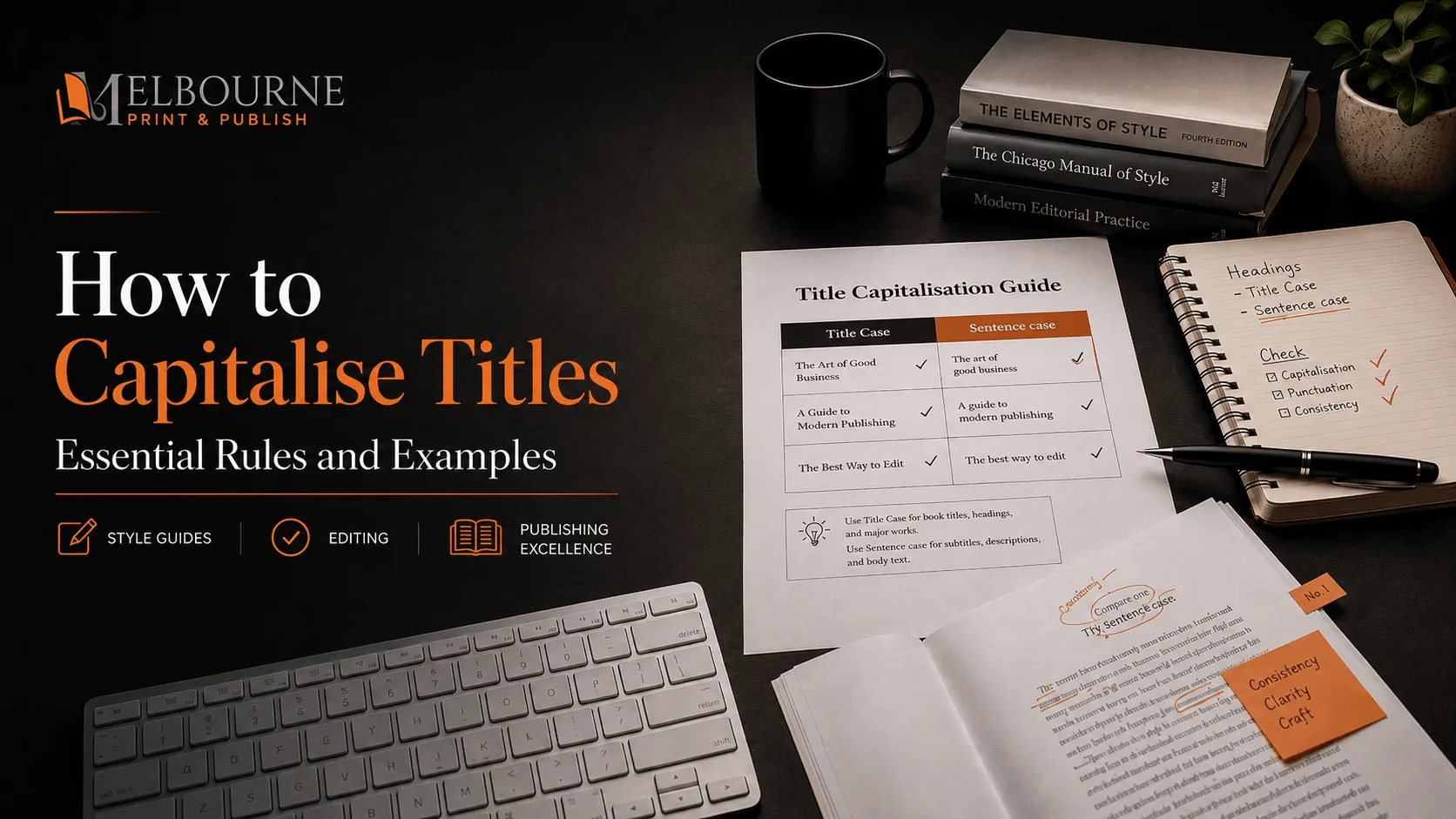
You have just spent twenty minutes arguing with yourself over whether "through" is a preposition or an adverb in your headline. Meanwhile your client is waiting and your coffee has gone cold. Let us fix that.
That moment, the freeze, the open browser tab with three "title case converters" all giving three different answers, is why this guide exists. Title capitalisation looks like a tiny mechanical task. It is not. It is one of those small things that quietly tells a reader, a client, or an editor whether you know what you are doing. Get it right and nobody notices, which is the point. Get it wrong and it is the first thing a sharp eye lands on.
Here is the honest problem. There is no single set of title capitalisation rules. There are at least five legitimate ones, and they disagree on purpose. Your last project might have run on Chicago. This one wants AP. The free tool you reached for defaults to a generic "title case" that matches none of them. So you patch together half-remembered advice, a bit of "just lowercase the short words," and a gut feeling, and end up with a heading that pleases nobody.
We can do better than gut feeling. This is your full, style-by-style, myth-busting reference for capitalising titles, written for the way Australians actually publish. You will get the logic underneath every rule, a side-by-side look at how the major guides differ, a system that holds up across clients and mediums, and a cheat sheet worth bookmarking. By the end you will capitalise titles quickly, accurately, and with the kind of quiet authority that makes people trust your work. As a team that handles manuscripts every day here at Melbourne Print and Publish, we know it is a skill worth owning.
Before you touch a single style guide, you need two building blocks solid in your head. The first is the difference between the capitalisation formats. The second is the parts-of-speech framework that quietly drives every rule on the planet. Master these and you stop memorising and start reasoning.
Half the confusion in this whole topic comes from people not agreeing on the terms. So let us pin them down before anything else.
So, what is title case? Title case means capitalising the first word, the last word, and all the major words in between, which is to say the nouns, pronouns, verbs, adjectives, adverbs, and, depending on the guide, some conjunctions and prepositions. It is the default for book titles, formal document titles, and most headlines. When someone asks what title case is, that first-word, last-word, major-words formula is the whole answer in one breath.
Sentence case is the gentler cousin. It capitalises only the first word and any proper nouns, exactly the way you would write an ordinary sentence. It is becoming the norm for blog subheadings, email subject lines, and interface labels, mostly because it reads more naturally and feels less shouty. It is also the house preference of the Australian Government Style Manual, which steers writers towards minimal capitalisation across headings and body text.
All caps and full lowercase exist too, but they are design choices rather than grammar. All caps works for a short label and falls apart across a long line. All-lowercase titles turn up in artistic contexts and tend to look unfinished everywhere else. Decide between title case and sentence case before you write the heading, not after, because retrofitting one onto a finished document is where inconsistency creeps in.
Now for the part that does the heavy lifting. Every title capitalisation rule rests on a single split: major words versus minor words.
Major words get capitalised. These are the nouns, pronouns, verbs, adjectives, adverbs, and subordinating conjunctions such as because, although, if, since, and when. They carry the meaning of the title. Once this is in your head you can reason through any title without a lookup table. "Is" is a verb, so you capitalise it. Yes, "Is" is a verb. Capitalise it. "My" is a pronoun, so it is capitalised. This is the same method editors use when training junior staff, because it builds a transferable instinct rather than rote recall.
Minor words get lowercased, with exceptions. These are the articles (a, an, the), the coordinating conjunctions (and, but, or, nor, for, so, yet), and the prepositions (in, on, at, with, from, between, and the rest). "The" is an article, so it stays lowercase unless it lands first or last. Where the guides argue is mostly about prepositions.
Prepositions are the one category that refuses to behave the same way across guides. Some guides judge them by length, others lowercase the lot regardless. This single disagreement is the source of most title-case arguments you will ever have, which is why each style section below spells out its preposition rule explicitly.
A handful of words wear more than one hat. "But" can be a coordinating conjunction or a preposition meaning "except." "Yet" can be an adverb or a conjunction. When a word can play two roles, work out which role it is playing in that specific title and treat it accordingly. Context decides, every time, and no length rule will make that judgment for you.
Inconsistent capitalisation reads as carelessness. For a freelance writer it can cost a client; for a brand it chips away at the polished image good content is meant to build. Correct capitalisation also helps people read, since capital letters act as visual anchors that let the eye parse a title in a single glance. In an Australian market where editors, university markers, and publishers are all reading closely, that first impression does real work.
No one rulebook governs all writing. Which guide you reach for depends on your industry, your client, and your medium. Below is a breakdown of the five most influential guides, a comparison matrix, and a single tricky title run through four of them so you can watch exactly where they split.
| Style guide | Commonly used for | English convention | Serial comma | Numbers | Titles and headings | Referencing style |
|---|---|---|---|---|---|---|
| Australian Government Style Manual | Government, public-sector, corporate and digital content | Australian English | Usually omitted unless needed for clarity | Write zero and one as words; use numerals for 2 and above, with exceptions | Sentence case | Depends on organisational requirements |
| ABC Style Guide | Journalism, broadcasting, news and online media | Australian English | Usually omitted unless needed for clarity | Spell out zero to nine; use numerals for 10 and above | Sentence case | Attribution and links rather than formal citations |
| Chicago Manual of Style | Book publishing, fiction, nonfiction and long-form content | Usually American English, adapted to Australian spelling when required | Generally required | Usually spells out zero through one hundred in general prose | Title case | Notes and bibliography or author-date |
| APA Style | Psychology, education, health and social-science research | American English, with Australian spelling permitted when used consistently | Required | Spell out numbers below 10; use numerals for 10 and above, with exceptions | Sentence case for book and article titles | Author-date citations |
| Australian Guide to Legal Citation, AGLC4 | Australian law, legal research and university assignments | Australian legal English | Depends on legal context | Uses specialised rules for cases, legislation, dates and legal documents | Depends on the type of legal authority | Footnotes and bibliography |
Associated Press style is built for speed and for saving space in tight columns, which is why its headline style is sometimes called "down style." It lowercases plenty of words that other guides happily capitalise. The core rule: capitalise the first and last words, all nouns, pronouns, verbs, adjectives, adverbs, and subordinating conjunctions. Capitalise prepositions and conjunctions of four letters or more, so with, from, about, and into all get a capital. Lowercase the articles, the coordinating conjunctions, and prepositions of three letters or fewer such as at, by, in, of, on, to, and up.
Take "How to Succeed in Business Without Really Trying." The "to" is a two-letter preposition, so it is lowercased. "Without" is a six-letter preposition, so it is capitalised. A common question lands right here: is "with" capitalised in a title? Under AP, yes, because it has four letters. That trips up writers who were taught to lowercase every short connecting word. Length is the deciding factor in AP, not feel.
Chicago title case (called "headline style" before the 18th edition, published September 2024) is the most traditional of the bunch and rules long-form publishing, including a lot of Australian book work. Capitalise the first and last words and all major words. Then lowercase every article, every coordinating conjunction, and prepositions of four letters or fewer. This is a deliberate change from the 17th edition, which lowercased every preposition regardless of length. So is "about" capitalised in a title under Chicago? Yes, as of CMOS 18, because it has five letters. "The House at Pooh Corner" still works for short prepositions: "at" stays lowercase because it is only two letters.
Hyphenated compounds in Chicago follow a clear rule: capitalise the second element unless it is an article, a preposition, or a coordinating conjunction. "Twentieth-Century Literature" capitalises both parts. "English-Speaking World" also capitalises both, because "Speaking" is none of those exception categories. The full rule lives in section 8.161 of the 17th edition (or the equivalent section in the current 18th edition, 2024) if you want the canonical source.
APA title case turns up in the title of your own paper and across reference lists, and it is more capital-heavy than Chicago. Capitalise every word of four letters or more, plus all nouns, pronouns, verbs, adjectives, adverbs, and subordinating conjunctions. Lowercase the articles, the coordinating conjunctions, and the prepositions of three letters or fewer. So in "Effects of Sleep Deprivation on Cognitive Performance in Young Adults," the words of, on, and in are all two-letter prepositions and all stay lowercase. APA also has a firm colon rule: always capitalise the first word after a colon or dash in a title, complete sentence or not. One detail that catches people out: in APA reference lists you apply title case to journal titles but sentence case to the article titles themselves.
MLA sits close to Chicago with a few sharp differences. Capitalise the first word, the last word, and all principal words. Lowercase the articles, the prepositions regardless of length, the coordinating conjunctions, and the "to" in infinitives. That last point is the one people overlook, and it lives in section 2.90 of the 9th edition. "A Room with a View" lowercases both "with" and "a." For hyphenated compounds, capitalise the first word after the hyphen unless it is an article, preposition, or coordinating conjunction, so "Gender-Neutral Language" capitalises "Neutral" because it is an adjective.
NYT style sits close to AP but with one quirk. Like AP, it capitalises prepositions of four letters or more and lowercases the articles and coordinating conjunctions. The wrinkle is that NYT also capitalises a handful of short prepositions, namely up, off, and out, even at two or three letters, while keeping other short prepositions like at, by, in, and for lowercase. So "What to Expect When You're Expecting" lowercases the two-letter "to" and capitalises "When" as a subordinating conjunction, but a title like "Living With Both Feet Off the Ground" shows the quirk in action: "With" is capitalised because it clears the four-letter bar, and "Off" is capitalised even at three letters because it sits on NYT's special-case list. Most online resources ignore NYT entirely, which is precisely why knowing it gives you an edge with media clients.
Here is where the theory earns its keep. Take one deliberately tricky title and run it through AP, Chicago, APA, and MLA at once. The points where they diverge are the exact points that cause editing paralysis.
Raw title: "a look at the long-term effects of social media on teen mental health: what the research says about the good, the bad, and the unexpected."
Under AP it becomes: "A Look at the Long-Term Effects of Social Media on Teen Mental Health: What the Research Says About the Good, the Bad, and the Unexpected." Note "About" capitalised, because a five-letter preposition clears AP's four-letter bar.
Under Chicago (18th edition) it matches AP, capitalising "About" because the word has five letters. Under APA it also capitalises "About" at four letters and up. Under MLA, however, "about" stays lowercase, because MLA lowercases every preposition regardless of length.
The single word "About" after the colon is the divergence point. AP, APA, and Chicago (18th edition) capitalise it; only MLA still lowercases it. The preposition "on" stays lowercase in all four. Stare at that one word and you understand why two competent editors can produce two correct, different versions of the same headline.
The standard major and minor rules handle about eighty per cent of titles. The other twenty per cent is where writers lose their nerve. Let us take the troublemakers one by one.
The rule shifts by guide, but the underlying instinct is steady: capitalise the second element when it carries real meaning or is a proper noun. Chicago capitalises the second element unless it is an article, a preposition, or a coordinating conjunction, which is why "Self-Reliance" gets both parts. APA capitalises both parts unless the second is an article, preposition, or coordinating conjunction, so "Step-by-Step" lowercases that middle "by." MLA follows the same instinct. AP capitalises the second element when it is a major word, so "Self-Help" capitalises both parts because "help" is a noun; the lowercase tail only appears when the second element is itself a minor word, as in "Mother-in-Law" where "in" stays down. When a compound genuinely sits in the gray zone, even seasoned editors disagree, and admitting that is more honest than pretending the rule is mechanical.
The colon is the most common subtitle separator, and everything hinges on what follows it. AP and Chicago capitalise the first word after a colon only when it begins a grammatically complete sentence or is a proper noun. APA and MLA take the simpler road and always capitalise the first word after a colon or dash, sentence or not. So "Writing Well: A Beginner's Guide to Clarity" is correct as written under APA and MLA, while a strict AP or Chicago reading would lowercase that "a" because the subtitle is a phrase rather than a full sentence. If your subtitle is a full sentence, capitalise the first word in every style. If it is a phrase, check your guide, and for client work, ask whether they have a preference, because a surprising number do.
A dash used in place of a colon behaves like a colon for capitalisation. Quotation marks inside a title are a little fiddlier. The cleanest approach, and the one experienced editors lean on, is to treat the quoted material as its own little title, apply title case to it independently, then drop it back into the larger title. "The Meaning of 'To Be or Not to Be' in Hamlet" is a good example: "Be" is a verb so it is capitalised, and most editors capitalise the opening "To" as the first word of the quoted phrase even though MLA would normally lowercase "to" in an infinitive. This is a judgment call rather than a hard rule, and confidence with it is a mark of experience.
Always preserve a proper noun's own capitalisation, even when it breaks every title rule you know. "iPhone," "eBay," and "YouTube" keep their internal letters because the name overrides the title case logic. Brand names with deliberate lowercasing, like "adidas," are usually best kept as the brand styles them in a title, for accuracy. When a name like "iTunes" opens a title, AP and Chicago both lean towards keeping the original form rather than forcing an awkward "ITunes." This same care belongs with acronyms and shortened forms too, and if you regularly wrestle with those, our breakdown of abbreviations, acronyms and initialisms and their correct usage pairs neatly with this section.
Phrasal verbs like "Break Down," "Give Up," and "Turn On" fool writers because the particle looks like a preposition. It is not. In title case you capitalise both parts, because the particle is doing the work of the verb. "How to Break Down Complex Topics" capitalises "Down." A quick test: if you can swap the verb and particle for a single synonym, "Break Down" becomes "Analyse," you are looking at a phrasal verb, so capitalise both halves.
Stop guessing. Run this six-step process every time you write or edit a title and you will land consistent, style-correct results in well under a minute.
Step One: Identify Your Style Guide and Medium. Is the piece journalistic? AP or NYT. A book manuscript or literary essay? Chicago or MLA. A social-sciences paper? APA. A government or corporate document? The Australian Government Style Manual, which means sentence case. A brand blog with no stated guide? Default to AP or build a small house style. If the client has named a guide, use it. If not, route by content type and default to AP for general web content.
Step Two: Choose the Case Format. Decide on title case or sentence case, usually dictated by the medium. Book titles, paper titles, and formal headlines take title case. Blog subheadings, email subject lines, social captions, and interface labels increasingly take sentence case, because it reads as conversational and tends to earn the click.
Step Three: Apply the Major-Words Rule. Capitalise the first and last words automatically, then capitalise every noun, pronoun, verb, adjective, adverb, and subordinating conjunction. This step is guide-agnostic and gets you ninety per cent of the way there. "the rise of artificial intelligence in healthcare" becomes "The Rise of Artificial Intelligence in Healthcare" on the first pass, with "of" and "in" still lowercase.
Step Four: Handle the Minor Words. Now apply your guide's specific rule to the leftovers. Check each preposition, article, and conjunction against the length threshold or the blanket rule. Under AP, a short "of" stays down but a "Between" would rise. Under MLA, every preposition stays down. Under APA and Chicago (18th edition), a length cutoff decides - four letters for APA, five for Chicago.
Step Five: Address the Special Cases. Scan for hyphens, colons, dashes, quoted material, and proper nouns, and apply the edge rules from the section above. Ask: is the second half of that compound a noun or equal force? Is what follows the colon a full sentence? Is that a phrasal verb hiding in plain sight? Is there a proper noun that needs protecting?
Step Six: Review for Consistency. Read the title aloud. Does it look balanced? If you are working across many titles in one document, make sure they all obey the same rule set. For a legacy audit, a spreadsheet with text functions can flag the obvious outliers, then you review the flagged items by hand. This is the same workflow used to train new copy editors in publishing houses, and it works because it turns a fuzzy task into a checklist.
Misinformation on this topic is everywhere, passed around in writing forums and outdated blog posts. Each of these myths leads to titles that look amateur. Let us state the myth, show the damage, then fix it.
Myth One: Always Lowercase Words Under Five Letters. Length has nothing to do with part of speech. "Is" is a verb, "be" is a verb, "do" is a verb, and they are all major words. A headline that reads "What is the Future of Work?" with a lowercase "is" looks like a typo to any editor. Identify the part of speech first, then apply the rule. Which is also the short answer to "should am be capitalised in a title": yes, because "am" is a verb.
Myth Two: Capitalisation Does Not Affect SEO. Search engines do ignore case for ranking, but readers do not. A cleanly capitalised title in the search results reads as more professional, which lifts click-through, and inconsistent capitalisation across a site quietly signals low quality. Prioritise natural readability over rigid rules when the two clash, because the goal is to earn the click.
Myth Three: All Short Prepositions Are Lowercase. Not in AP, where "With" at four letters is capitalised, and not in APA either. As of CMOS 18 (September 2024), Chicago also capitalises prepositions of five letters or more, so only MLA still lowercases every preposition regardless of length. A writer who lowercases "With" while otherwise following AP has built a hybrid that satisfies no guide at all.
Myth Four: You Must Capitalise Every Word in a Title. That is start case, not title case. Title case deliberately lowercases the minor words to create hierarchy and rhythm. "The House At Pooh Corner" with a capital "At" looks wrong to anyone who knows Chicago. Embrace the lowercase minor words; they make the major words stand out.
Myth Five: Sentence Case Is Unprofessional. It is the standard on plenty of modern platforms, from Medium to most email newsletters to interface design, and the Australian Government Style Manual recommends it outright. It often reads as warmer and more approachable. Use it freely for subheadings, subject lines, and captions, and keep title case for formal and book titles.
Myth Six: Automated Tools Are Always Right. Most default to a single generic style or stumble on hyphenated compounds, phrasal verbs, and proper nouns. They are a starting point, not a final authority. Use them for batch work, then spot-check a slice of the output by hand.
Myth Seven: There Is One Universal Title Capitalisation Rule. There are at least five legitimate, distinct rule sets. Applying Chicago in an AP newsroom marks you as an outsider. Amateurs hunt for the one rule. Professionals manage the differences, which is the entire skill.
A few public mistakes make the lessons stick. A knock-off cover reading "The Girl On The Train" capitalises "On" and "The" where Chicago would lowercase both. A press release announcing "Professor Wins Award for 'groundbreaking Research'" should capitalise "Groundbreaking" as the first word of the quoted title. A blog headline reading "How to Set-up Your Account" carries two errors at once, since "set up" is a two-word phrasal verb here, not a hyphenated one; the fix is "How to Set Up Your Account." Small slips, every one visible to the exact reader you are trying to impress.
Knowing the rules is half the job. Applying the right one to the right deliverable is the other half. Here is how the choice shifts across the work you are most likely to produce.
In APA, the paper's title on the title page uses title case, and so do all heading levels, while the article titles inside a reference list switch to sentence case. MLA puts the paper title in title case and generally uses title case for section headings, though it leaves the finer detail to the instructor or publisher. Australian universities usually nominate one referencing style per faculty, so always check your unit guide, because many apply small local variations on top of the standard. If you are submitting a thesis or journal article and want a second set of eyes on the mechanics, our academic proofreading services exist for exactly this kind of precision work.
Chicago is the default for trade books, fiction, and narrative non-fiction across much of the Australian publishing scene. Chapter titles and part titles take title case, while running heads may go either way depending on the design. Fiction occasionally bends the rules for effect, a chapter title set in all lowercase for a dream sequence, say, but that is a design choice rather than a grammar one. Capitalisation is only one slice of the craft that makes a novel land; the bigger swings live in technique, which is why writers who care about titles also tend to care about what magical realism actually is, how techniques like foreshadowing seed a payoff, and how the omniscient point of view shapes a reader's trust. If you have the story but not the hours, our fiction ghostwriting and broader ghostwriting work can carry a manuscript from idea to finished page.
AP headline style influences a lot of newsrooms, built for tight spaces and quick scanning, while many Australian mastheads keep their own in-house guides on top of it. Remember that prepositions of four letters and up get capitalised in AP, which makes its headlines look slightly more "up-style" than Chicago. For breaking news on mobile, some outlets now switch to sentence case for readability, so confirm the publication's digital style before you commit.
This is where strict grammar bends to marketing reality. For an SEO title tag, the first fifty to sixty characters are what show, and while title case reads as authoritative, sentence case often reads more naturally and lifts click-through, so test both. Email subject lines lean sentence case, because it mirrors conversation and dodges the spam-filter triggers that excessive capitals invite. Never set a subject line in all caps. Social captions are sentence case by default. The thread running through all of this is that your title is doing marketing work, and good book marketing treats every headline as a tiny ad. The same instinct extends to the assets around the book, from an author website where your headings set the tone, to book trailer videos where on-screen titles need the same discipline, to the way an e-book presents its chapter heads on a small screen.
Whitepapers and B2B reports usually take title case for the main title and section headings to project authority, though many Australian brands now favour sentence case for a more approachable tone, in step with the Style Manual. The call should follow the company's brand voice rather than your personal preference. Long-form non-fiction of this kind lives or dies on clarity, and our non-fiction ghostwriting service is built around making dense material readable without losing its rigour.
In web content, a common pattern is title case for the H1 and sentence case for the H2s and the levels beneath them, which creates a clear visual split between the main topic and the supporting points. Some design systems use title case throughout, right down to the H6. Either is fine. What matters is consistency within a single piece and across the site, which is a formatting concern as much as a grammar one, and clean, consistent headings are part of what proper book formatting delivers. Document your choice in a style sheet and the whole question stops being a decision you re-make every time.
You do not have to run on memory alone. A few tools and references will speed the work and catch the errors you are too close to see.
Capitalize My Title is a free converter that turns a pasted title into AP, Chicago, APA, MLA, or NYT case, as well as sentence case. It is the strongest free option because it names the guides explicitly rather than running a generic algorithm. Use it for fast first-pass conversions, then review the hyphenated compounds and proper nouns by hand, because that is where it slips.
Grammarly's paid plans let you set style preferences, including capitalisation, and run consistency checks across a team's writing. It is not a dedicated title tool, but it catches heading inconsistencies inside a document, and a shared team style guide cuts editing time.
PerfectIt is a Microsoft Word add-in built for professional editors and widely used across the Australian editing industry. It checks document consistency, including heading capitalisation and hyphenation, and you can set it to enforce Chicago, AP, or your own house style. Run it after a manuscript or a large content audit to surface headings that drift from your pattern.
No tool replaces the primary sources. Online subscriptions to the Chicago Manual of Style, the AP Stylebook, the APA Publication Manual, and the MLA Handbook give you searchable access to the exact rules. For Australian spelling decisions that sit beneath the capitalisation, the Macquarie Dictionary is the national standard, and the Australian Government Style Manual is the reference for public-sector and much corporate writing.
For multi-client work, the single most useful resource is one you build yourself. Record each client's preferred guide, dictionary, and house exceptions, things like "always capitalise 'Internet'" or "capitalise prepositions over two letters in headlines." Note the subheading rule and any quirks. That sheet becomes your single source of truth and stops you applying last client's rules to this client's work.
If you would rather hand the whole mechanical layer to specialists, that is also a legitimate strategy. A dedicated round of professional editing catches the structural and stylistic issues, while focused book proofreading services handle the final polish where capitalisation slips usually hide. If you are unsure how those two stages differ, our plain-English explainer on what proofreading actually involves lays it out. And because publishing is rarely just words on a page, the surrounding pieces matter too: the cover and book design, the artwork through professional book illustration, the physical product via book printing, and the full path through the publishing process all sit alongside the editorial work. If you are taking a manuscript all the way to market, it also helps to understand how to self-publish a book in Australia, the practical steps of how to get an ISBN for self-published books in Australia, and how to copyright a book in Australia. Even a small word-choice question, like weighing the difference between endorse and approve, feeds the same eye for detail.
Bookmark this part. It compresses everything above into a single scan.
Title capitalisation is not arcane trivia. It is a visible marker of editorial competence. Get it right and clients trust you with more. Get it wrong and a tiny error casts a long shadow over otherwise good work.
You now have the full system: the parts-of-speech logic, the style-by-style comparison, the edge-case rules, the six-step workflow, the seven myths, and the contextual judgment to apply the right standard to the right job. Bookmark the cheat sheet, build your master style sheet, and let the tools handle the grunt work while you spend your attention on the genuine gray areas.
The rules will shift. Guides update, digital conventions move. The real mark of a professional is not knowing every answer by heart but knowing where to find the current one and when to make a reasoned exception. Stay precise, stay curious, and keep being the editor who catches what everyone else walked straight past.
Australia does not have a single official title case system of its own. Most writers and publishers here follow one of the major international guides depending on the work: Chicago for book publishing, APA or MLA for academic writing, and AP for journalism. The Australian Government Style Manual, used across the public sector and much corporate communication, favours sentence case for headings and a restrained, minimal-capitalisation approach. The practical move is to pick the guide that matches your medium and apply it consistently, using Australian English spelling throughout.
Only when it is the first or last word of the title, or part of a proper noun. "The" is an article, which makes it a minor word, so in the middle of a title it stays lowercase across every major guide. "The Lord of the Rings" capitalises the opening "The" because it leads the title, and lowercases the second "the" because it sits in the middle.
It depends on the guide you are following. Under MLA, all prepositions stay lowercase no matter how long they are. Under AP and APA, prepositions of three letters or fewer are lowercase while those of four letters or more are capitalised. Under Chicago (18th edition, 2024), prepositions of four letters or fewer stay lowercase and those of five letters or more are capitalised. Since Australian publishing borrows from all of these, the answer is to settle on one guide first, then apply its preposition rule consistently.
Coordinating conjunctions, which include and, but, or, nor, for, so, and yet, are lowercased in title case unless they fall in the first or last position. Subordinating conjunctions such as because, although, and when are treated as major words and are capitalised. So "and" stays lowercase in the middle of a title, while "Because" would be capitalised.
Usually not. As a short preposition, "to" is lowercase in AP, APA, Chicago, and MLA when it sits mid-title. MLA also specifically lowercases the "to" in an infinitive, as in "How to Write." The exception across all guides is when "to" opens or closes the title, in which case it is capitalised.
Both, and the choice depends on context. Book publishers tend to use title case for chapter and part titles. The Australian Government Style Manual and many corporate guides lean towards sentence case for headings because it reads as cleaner and more modern. In web and digital content, a common pattern is title case for the main heading and sentence case for the subheadings beneath it. Consistency within a single document matters more than which one you pick.
The minor words: articles (a, an, the), coordinating conjunctions (and, but, or, nor, for, so, yet), and prepositions, with the length threshold for prepositions depending on your chosen guide. These stay lowercase unless they land in the first or last position of the title. Everything else, the nouns, verbs, adjectives, adverbs, pronouns, and subordinating conjunctions, is capitalised.
No, not in the middle of a title. Articles are minor words and stay lowercase in every major style guide, with the single exception of when they appear as the first or last word of the title. That is why "A Tale of Two Cities" capitalises the opening "A" but a mid-title "a" or "the" would stay lowercase.
It depends on the referencing style the faculty requires, which is most often APA or MLA. In APA, the paper title and all heading levels use title case, while article titles in the reference list switch to sentence case. In MLA, the title and section headings generally use title case. Always check your specific unit guide or faculty handbook, because many Australian universities apply small local variations on top of the standard style.
Title case capitalises the first word, the last word, and all the major words in between, lowercasing only the minor words such as short articles, conjunctions, and prepositions. Sentence case capitalises only the first word and any proper nouns, exactly as you would write an ordinary sentence. Title case suits book titles and formal headlines, while sentence case suits blog subheadings, email subject lines, and interface text, where it reads as more natural and approachable.


Explore the 12 character archetypes, from Heroes and Rebels to Sages and Rulers. Discover their traits, motivations, flaws and how to make them memorable.
Go beyond literal words and discover how figurative language creates vivid images, deeper meaning and emotion through metaphors, similes and more.