Think about the last time a story genuinely stunned you. The moment a reveal landed so cleanly that you sat back and thought, how did I not see that coming? And then, almost immediately, you started flipping back through the pages in your head, piecing it all together. That moment where surprise and recognition crash into each other at once, that is foreshadowing done right.
It is one of the most powerful tools in a writer's kit. And it is also one of the most misunderstood. A lot of writers either avoid it entirely out of fear of giving too much away, or they lean on it so hard that readers can see the ending coming from chapter two. Neither of those is what you are going for.
This guide is going to walk you through everything: what foreshadowing actually is, why it matters in storytelling, the different types you can use, how to weave it in without being heavy-handed, and the most common mistakes writers make and how to fix them. Whether you are working on your first novel with the help of a professional publishing team or you are deep into your fifth draft trying to tighten up the structure, this is the guide you need.
At its core, foreshadowing is a literary device in which an author drops hints or clues early in a story that point to events that will occur later. It is not a spoiler. It is not a cheat. When it works, readers do not even consciously notice it on the first read. They only recognise it on the second, or after a big reveal, when everything clicks into place.
The meaning of foreshadowing runs deeper than just planting clues, though. Done well, it creates a sense of inevitability. When the ending finally arrives, readers should feel like, of course that is what happened. Not surprised in a cheap way, but satisfied in a way that feels earned. That emotional payoff is the whole point.
It is also worth separating intentional foreshadowing from accidental hints. When a detail shows up early in a story and becomes important later simply because the writer got lucky or was inconsistent, that is not foreshadowing. Foreshadowing requires intent. It is a deliberate choice to place something in the narrative now so that it resonates later.
The difference matters for craft. If you are serious about building a story that holds together with real structural intelligence, understanding foreshadowing in literature is non-negotiable. It is the kind of thing that separates a story that is merely readable from one that people reread, recommend, and remember. Just like understanding the definition of an antihero or mastering the omniscient point of view, foreshadowing is one of those foundational concepts that shapes how readers experience your story from the very first page.
So why is foreshadowing used at all? The short answer is that it does several jobs at once, often without the reader realising any of them are happening.
When a reader senses that something is coming, even without knowing what it is, that low-level tension keeps them turning pages. It is the difference between a story that feels flat and one that pulls you forward. Good foreshadowing creates a kind of unease that readers often describe as not being able to put the book down. They cannot always explain why. It is because the narrative has trained them to feel like something is about to happen.
This works because of how human brains process narrative. We are pattern-recognition machines. We pick up on repeated details, symbolic language, and structural signals even when we are not consciously aware of doing so. Foreshadowing taps directly into that instinct.
Foreshadowing is not just about plot. Some of the most powerful uses of the device are thematic. A recurring image, an object that keeps appearing, a phrase a character returns to more than once. These things carry meaning that extends beyond what happens in the story to say something about why it happens. When your hints are tied to your themes, the revelation at the end of the book feels like more than just a plot event. It feels like the story has been building toward something true.
Characters foreshadow things too, not just events. A character who is fiercely independent in chapter one might be hinting at the moment later in the story when that independence becomes both their greatest strength and their most damaging flaw. Foreshadowing character arcs is one of the more subtle forms of the technique, but it is also one of the most satisfying for readers when it pays off.
Dialogue, internal monologue, and the way a character reacts to small things can all function as foreshadowing. A passing comment that feels like throwaway banter can become devastatingly meaningful three hundred pages later.
One of the most interesting uses of foreshadowing is when the reader picks up on something the character has not. The character walks into a situation thinking everything is fine while the reader, armed with the earlier hint, can see exactly where this is heading. That gap between what the character knows and what the reader suspects creates dramatic irony, and it is incredibly effective at building tension and emotional investment.
There is a very specific feeling readers get when a reveal lands well and they immediately think back to the clue they missed the first time. It is a moment of recognition, a small rush of satisfaction that says this story respected me enough to be honest with me all along. That feeling keeps readers loyal. It is what makes people reread books and tell their friends to pay attention the second time through.
Understanding what foreshadowing is in literature means understanding that it is not a single technique. It is a family of techniques, each one working differently and serving different narrative purposes. Here is a breakdown of the main types.
| Type of Foreshadowing | Description | Example / Purpose |
|---|---|---|
| Direct Foreshadowing | The story openly hints at future events through warnings, prophecies, or ominous statements. | In Romeo and Juliet, the opening Chorus directly tells the audience the lovers will die, framing the whole play. |
| Indirect Foreshadowing | Subtle hints are placed through imagery, setting, symbols, or small details without directly revealing future events. | In The Great Gatsby, the green light symbolises Gatsby’s unreachable dream long before the theme becomes obvious. |
| Prophetic Foreshadowing | Uses prophecies, dreams, visions, or supernatural predictions to shape future events. | In Macbeth, the witches’ prophecies drive Macbeth’s actions and the plot itself. |
| Symbolic Foreshadowing | Objects, colours, animals, or recurring images gain deeper meaning and hint at future developments. | In The Hunger Games, the mockingjay pin gradually becomes a symbol of rebellion. |
| Chekhov’s Gun | Every important detail introduced should eventually become relevant to the plot. | A gun shown early in a story is expected to be used later, creating narrative payoff. |
| Red Herrings | False clues that mislead readers and distract them from the real outcome. | Common in mystery stories where suspicious characters appear guilty but are innocent. |
| Atmospheric and Mood Foreshadowing | Weather, setting, or tone creates emotional hints about upcoming events. | A dark storm before tragedy creates tension and signals danger ahead. |
| Dialogue Foreshadowing | Casual remarks or conversations hint at future events without seeming obvious initially. | A throwaway joke later gains serious meaning after key events unfold. |
| Character Foreshadowing | A character’s habits, fears, or skills hint at their future role in the story. | A character introduced as skilled at lock-picking later uses that ability during a crucial moment. |
Knowing the types is one thing. Knowing how to actually use them in your writing is another. Here is a practical breakdown.
This is the single most important piece of advice for foreshadowing well. You cannot plant hints for a destination you have not mapped yet. If you know where your story is going, you can seed the beginning and middle with details that will resonate when you get there. That does not mean you have to write linearly. Many writers draft the full story first and then go back through to layer in the foreshadowing. But the foreshadowing should always be written with the ending in mind.
Know your major plot twists, your character arcs, and your thematic beats before you start seeding. Even a rough outline helps.
Once you know what you are foreshadowing, brainstorm the different forms it could take. Can you embed it in dialogue? Can an object carry the weight? Is there a way to use setting or atmosphere? Having a list of potential hints gives you options and means your foreshadowing is more likely to feel varied and organic rather than repetitive.
Story planning tools like Scrivener or Plottr can be genuinely useful here. If you are working with a ghostwriting service, make sure your collaborator understands the structural payoffs you are building toward so the foreshadowing can be seeded consistently across the manuscript.
When you are in the drafting phase, plant small, seemingly unimportant details early on. These should feel like texture, like part of the world, not like red neon signs pointing to the future. The best foreshadowing is the kind that reads as normal scene-setting until the reader looks back and realises it was doing something much more specific all along.
Use evocative imagery, recurring motifs, and the natural rhythms of your character's inner world. A character who flinches at a particular sound, or who avoids a certain part of town, or who cannot stop thinking about a person they lost three years ago - these small details carry weight if you know what they are building toward.
Do not rely on any single method. If all your foreshadowing comes through ominous weather, it starts to feel formulaic. If every significant future event is signalled by a character's dream, readers will start expecting them. Mix dialogue foreshadowing with symbolic objects, atmospheric shifts, and character behaviour. The variety keeps the technique invisible and the texture of the story rich.
Once you have a complete draft, read through it specifically looking for your foreshadowing. Ask yourself honestly: are the hints there? Are they too obvious? Are they so subtle they basically disappear? Both of those are problems. You want hints that exist clearly enough to be recalled when the revelation arrives, but that do not telegraph the answer so blatantly that attentive readers see it coming fifty pages in advance.
This is also a good moment to think about professional editing support. A skilled editor reads your manuscript fresh, without your knowledge of where the story goes, and their reaction to the hints is exactly the kind of feedback you need. Melbourne Print and Publish offers professional editing services that include structural and developmental work, which is exactly the level at which foreshadowing operates.
Once you know your plot is solid, go back through the manuscript and look for scenes where you can add another layer. A conversation that already works can sometimes be deepened by a small detail, a word choice, a physical gesture, that will resonate later. Revision is where foreshadowing becomes artistry, because you are now shaping something you can see whole.
The goal is hints that are ambiguous enough not to spoil the reveal, but clear enough to be satisfying in retrospect. That balance is genuinely difficult to get right, and it often takes multiple rounds of feedback to calibrate. Beta readers are invaluable here. Share your work with people who will tell you honestly when something is too obvious or when a supposed hint felt invisible. Adjust accordingly.
Even experienced writers get this wrong. Here are the most common foreshadowing mistakes and exactly how to avoid them.
When a hint is so clear that readers can see the ending coming from miles away, the reveal loses all its power. Readers feel clever, but not in the right way. The feeling is more like the author underestimated them, and that is a trust problem.
The fix is to integrate hints into the natural fabric of the scene. They should not feel like hints. They should feel like texture. If a detail is drawing too much attention to itself, either bury it in a longer scene or reframe it as something that could plausibly mean several different things.
The opposite problem. The hints are there, but so obscure that when the revelation arrives, readers feel no recognition at all. The payoff falls flat because nothing was set up to land against.
The fix is to layer. If one hint is very subtle, add another one in a different form. Reinforce it. Tie it to character motivation so it feels more anchored. The goal is that even if readers miss hint one and hint two, hint three lands clearly enough that the reveal still resonates.
This is when hints are present but poorly executed in a way that creates confusion rather than intrigue. The reader is not sure what they are supposed to be picking up on, and when the revelation arrives, their reaction is more baffled than satisfied.
The fix is clarity of intent. Even if the meaning of a hint should be ambiguous, the fact that something is being signalled should not be. Simplify the setup. Make sure the hint is tied to something concrete, a character's fear, an object, a physical sensation, so that readers have something real to hold onto even if they do not understand its significance yet.
Dark and stormy nights, ravens perching on windowsills, a sudden chill in the air. These are not inherently bad techniques, but they are so overused that readers no longer feel them. The familiarity flattens the effect.
The fix is originality. Look at what your story is specifically about and find foreshadowing that is native to that world and those characters. A story set in a restaurant kitchen can foreshadow through the way a sauce is described. A story about a tech startup can use code as a metaphor. The best foreshadowing grows organically from the world of the story, not from a generic toolkit of literary signals.
Introduce a significant detail, build some weight around it, and then let it disappear without resolution. Readers feel cheated. This is the Chekhov's Gun principle in reverse: if you show the gun and then never fire it, you have made a promise you did not keep.
The fix is ruthless revision. Every significant hint should lead somewhere. If you introduced something in an early draft and the story moved in a different direction, either rework the story to make it pay off or cut the hint entirely. Unresolved foreshadowing is worse than no foreshadowing at all.
The best way to understand how foreshadowing works is to look at how brilliant writers have used it. These examples are worth studying closely.
The witches' prophecies in Macbeth are some of the most studied examples of prophetic foreshadowing in all of literature. The genius of what Shakespeare does is that the prophecies are clear, but their interpretation is not. Macbeth hears what he wants to hear. The audience hears something else entirely. That gap between what the character understands and what the prophecy actually means drives the entire tragedy forward.
The foreshadowing is also thematic. The witches do not just predict events; they hint at the nature of ambition and self-deception. Every detail in their words reflects something true about Macbeth that he refuses to see. That is foreshadowing working on multiple levels simultaneously.
Rowling is a masterclass in long-form foreshadowing. Details planted in the first book do not pay off until the seventh. Snape's behaviour, Dumbledore's choices, the objects later revealed as Horcruxes, like Riddle's diary, all of it was quietly embedded in the early books in ways that seemed like incidental detail at the time. The revelation about Snape in particular works so well precisely because the foreshadowing is built into his every interaction with Harry from the beginning. Readers who reread the series find it everywhere.
The lesson here is that foreshadowing can operate across a very long timeline if the structural discipline is there to support it.
Martin's series is famous for its intricate web of prophecies, dreams, and political manoeuvres that foreshadow major events. The foreshadowing of Jon Snow's true parentage, for instance, is visible across multiple books, embedded in conversations, dreams, and symbolic details that casual readers miss entirely on first read. The Red Wedding is another example: Martin seeded the betrayal long before it happened, through small behavioural details and political context that made the event feel inevitable rather than arbitrary once it arrived.
This is foreshadowing as architectural intelligence. The story is structured so that the major reveals grow naturally from what was already there.
Arguably one of the most famous examples of cinematic foreshadowing, the film uses visual and auditory cues throughout to hint at its ending in a way that is almost invisible on a first watch. Every scene contains information that looks different once you know what you are actually watching. The revelation recontextualises the entire film. That is the gold standard of what foreshadowing can achieve: a story that exists on two levels at once, rewarding both the first-time audience and the one that comes back knowing the ending.
Use this as a working reference when you are drafting, revising, or evaluating your own foreshadowing.
Have you identified all major plot twists, revelations, and character arcs you want to foreshadow? Do you know the specific purpose of each hint, whether it is building suspense, reinforcing theme, or developing character? Is your foreshadowing consistent with the overall tone and genre of the story?
Have you planted hints early enough in the narrative that they have time to settle? Are they subtle enough not to spoil the reveal on first read, but clear enough to be satisfying in retrospect? Have you varied your methods, using dialogue, symbolism, atmosphere, character action, and other forms rather than relying on one technique? Have you layered multiple hints for the most important revelations?
Have you checked that nothing is too obvious or too reliant on cliché? Are your red herrings doing real misdirectional work rather than just adding noise? Does every significant hint ultimately pay off? Have you combed through the manuscript for unintentional hints that might confuse or mislead in ways you did not intend?
Have you gone back through the manuscript in revision specifically to seed more organic foreshadowing? Have you tested your hints with beta readers? Do they notice them without guessing the full revelation? Have you thought about the psychological experience of the hints, what emotional register they create, and whether that register is the one you want?
If you are not yet working with a professional structural editor, it is worth considering. Good book proofreading services in Melbourne and professional editing work together to ensure your manuscript is both technically clean and structurally sound. Foreshadowing operates at the structural level, which is exactly what developmental editors are trained to assess.
Foreshadowing does not work the same way in every genre. The expectations readers bring to different types of fiction shape what kinds of hints feel appropriate and what kinds feel out of place.
These genres live and die by foreshadowing. Every clue is a form of it. Every red herring is a deliberate misdirection. Readers in these genres are actively looking for hints, which means the bar for subtlety is higher. A hint that would be invisible in literary fiction can feel like a flashing arrow in a mystery novel because the reader is already primed to notice everything.
In thrillers, atmospheric foreshadowing works particularly well because it can build tension without tipping off the plot. The mood of a scene can signal danger without giving the reader any specific information to act on.
World-building creates natural opportunities for foreshadowing because rules of magic systems, technology, or social structures can be introduced early and then pay off later. A magic system with a specific limitation becomes foreshadowing the moment that limitation becomes the hinge point of a crisis. The challenge in these genres is that foreshadowing has to work alongside a lot of expository information, so the hints need to be especially well embedded to avoid getting lost in the world-building.
If you are writing genre fiction and planning to self-publish a book in Australia, getting the structural elements right from the beginning will make a significant difference to how your book is received. Strong foreshadowing is part of what signals to readers that they are in capable hands.
Literary fiction uses foreshadowing most often in its thematic and symbolic forms. The hints are rarely about plot events in a conventional sense. They are more likely to be about a character's internal truth, a recurring image that accumulates meaning, or a structural echo that appears in a new context later in the book. Readers of literary fiction tend to be close readers, which means foreshadowing can be more oblique, but it needs to be genuinely meaningful rather than decorative.
Romantic foreshadowing is about emotional inevitability. The reader needs to feel from early on that these two characters are heading toward each other, even when the story is throwing obstacles in their way. That emotional pull is created through foreshadowing: shared moments that seem insignificant but carry charge, dialogue that hints at deeper feeling, physical details that keep coming back. When the relationship finally resolves, it should feel like everything was always leading here.
Foreshadowing does not operate in isolation. It is always in conversation with the other elements of your story.
Foreshadowing and dramatic irony are close relatives. When the reader picks up a hint that a character misses, the stage is set for dramatic irony. The reader knows, or suspects, something the character does not. That gap creates emotional tension that can be devastatingly effective when handled with care. The character walks into danger unaware while the reader watches, helpless, knowing what is coming.
Symbolic objects and images often double as foreshadowing. A recurring symbol does not just carry thematic meaning; it can also be quietly pointing toward a future event. The skill is in making the symbol feel natural in its immediate context while also doing its structural work. When the symbol pays off in a plot sense, the thematic resonance deepens at the same time.
This is one of the most common questions writers ask when they are learning to use the technique. Foreshadowing is the setup. A plot twist is the event. They are not the same thing, but good foreshadowing is what makes a plot twist feel satisfying rather than arbitrary.
A plot twist without foreshadowing is just a surprise. It might be shocking, but it will not be satisfying. The reader's reaction will be more disorientation than revelation because nothing has prepared them for it. A well-foreshadowed twist, on the other hand, creates that specific feeling of things clicking into place, of the story having been honest with you all along even when you were not paying the right kind of attention.
Yes, absolutely. In fact, the best foreshadowing usually is. The goal is hints that are fully present and structurally load-bearing without announcing themselves to first-time readers. Subtle foreshadowing is the kind that readers look back on and say, how did I miss that? It was right there.
The way to achieve this is context. Embed your hints in scenes that are doing other things. A detail that is foreshadowing your ending can also be developing character, establishing setting, or advancing a subplot. When a detail is doing multiple jobs, it is much less visible as a structural signal. It just feels like good writing.
Hidden foreshadowing often works through the emotional register of a scene rather than through specific content. Readers might feel a sense of unease without knowing why. That feeling is the foreshadowing working on a pre-conscious level. It lands in the body before it lands in the mind, which is what makes it so powerful.
Foreshadowing is not just a device for creating suspense. It is also a form of communication between the author and the reader. When you foreshadow well, you are telling your reader, pay attention, this matters, something is building here. You are inviting them into a more active and engaged kind of reading.
That engagement has structural benefits too. When readers are attuned to the possibility of hidden meanings and future payoffs, they read more carefully. They invest more in the details. They form stronger emotional attachments to characters and events because they understand that nothing in the story is accidental. That understanding creates trust, and trust is what makes the emotional moments land.
Readers of a well-foreshadowed story come away feeling like they participated in something crafted with intelligence and care. They want to tell other people about it. They want to read it again. That is the kind of reader experience that sustains an author's career. If you are thinking about what your book needs structurally before you go into book design or publishing, getting the foreshadowing right is one of the most important foundational decisions you will make.
Foreshadowing is not a trick. It is not a technique you bolt on at the end to make the story feel cleverer. It is a fundamental part of how stories communicate with readers, how they build trust, create meaning, and earn the emotional moments they are working toward.
The writers who use it best do not think of it as separate from the story. They think of it as part of the story's texture, part of the world they are building and the characters they are developing. Every detail becomes an opportunity. Every scene carries potential weight. That is a demanding way to write, but it is also a deeply satisfying one.
Take what is here, the types, the techniques, the checklist, the examples, and start paying attention to foreshadowing in the fiction you are already reading. You will find it everywhere, now that you know what you are looking for. And once you understand how it works in other people's hands, you will start to see how it can work in yours.
If you are at the stage where you are ready to take your manuscript seriously and want professional support getting it into the best possible shape, Melbourne Print and Publish is here to help. From fiction ghostwriting services and non-fiction ghostwriting to professional editing, book design, and book marketing in Melbourne, we work with authors at every stage of the process. Your story deserves to be told well. Go weave your invisible threads.
Foreshadowing is a literary device where an author plants hints or clues early in a story that point toward future events, character developments, or thematic revelations. The hints are designed to be subtle enough that readers do not fully grasp their significance on first read, but recognise them clearly once the payoff arrives.
In literature, foreshadowing refers to the technique of embedding signals of future events into earlier parts of the narrative. It is used to build anticipation, create structural coherence, and reward attentive readers. Foreshadowing gives stories a sense of inevitability, making the ending feel earned rather than arbitrary.
Foreshadowing is used to build suspense, deepen thematic resonance, develop character arcs, and create dramatic irony. It increases reader engagement by making the story feel structurally intelligent. When readers sense that details are connected to something larger, they invest more deeply in the narrative.
Common examples include the witches' prophecies in Macbeth, the mockingjay pin in The Hunger Games, Snape's behaviour in the Harry Potter series, and the carefully planted visual cues in The Sixth Sense. Each of these uses a different form of foreshadowing, from direct prophecy to symbolic objects to behavioural hints.
Foreshadowing creates a framework of meaning that readers pick up on intuitively, even without consciously analysing it. It signals to readers that the details of the story are intentional and connected. When a foreshadowed event arrives, readers experience both the immediate impact of the event and the deeper satisfaction of structural coherence.
Foreshadowing is the technique; a plot twist is the event. Foreshadowing sets up a twist. Without foreshadowing, a twist feels arbitrary. With it, the twist feels inevitable in retrospect. The difference between a cheap surprise and a satisfying reveal is almost always the quality of the foreshadowing that preceded it.
The main types include direct foreshadowing, indirect foreshadowing, prophetic foreshadowing, symbolic foreshadowing, Chekhov's Gun, red herrings, atmospheric foreshadowing, dialogue foreshadowing, and character foreshadowing. Each operates differently and serves different narrative purposes. The most effective stories use several types in combination.
Authors use foreshadowing to create structural integrity, build suspense, develop themes, and make the reading experience more satisfying. A well-foreshadowed novel holds together in a way that a loosely structured one does not. It signals craft and intentionality, both of which build reader trust.
Yes, and ideally it should be. The best foreshadowing is fully present in the text but does not draw attention to itself on first read. Readers should recognise it in retrospect rather than notice it in the moment. Embedding hints within scenes that are doing other narrative work is one of the most reliable ways to achieve this.
Foreshadowing is used at every level of narrative structure: in individual scenes, across chapters, and spanning entire books. It can be embedded in dialogue, setting, character behaviour, symbolic objects, dreams, and atmospheric details. The key is intentionality: every hint should be deliberate and should lead somewhere meaningful.


Learn how to write a short story that lands. A practical 2026 guide to structure, compression and getting published, from Melbourne Print & Publish......
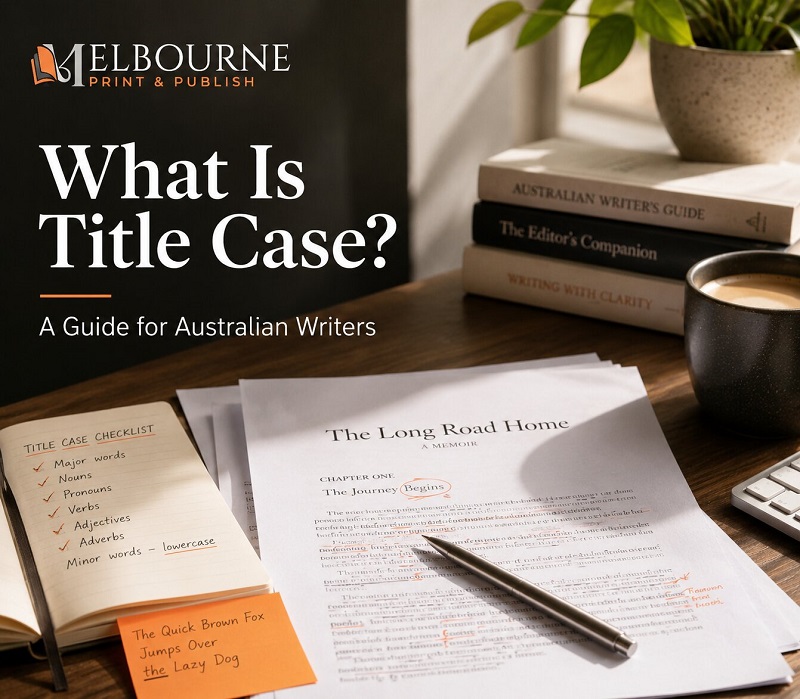
Learn what title case is, how it differs from sentence case, and how to capitalise titles correctly in Australian English, with rules and examples.....
.webp)
Practical methods, beat sheets and Aussie tips to outline a novel from logline to scene list. Build a working roadmap with Melbourne Print and Publish....