
You've just finished writing. Maybe it's a university assignment. Maybe it's a business proposal that could land you a major client. Or maybe it's the manuscript you've spent the last two years pouring yourself into. You read it over once, feel good about it, and hit send.
Then, three hours later, it hits you.
"The manger reviewed the report." Not manager. Manger. As in a feeding trough.
It's one of those errors that spell check won't catch, your brain skipped right over, and your reader absolutely noticed. That's the thing about writing errors, they rarely announce themselves. They sit quietly in your text, waiting to embarrass you at the worst possible moment.
This is exactly why proofreading exists. And if you've ever wondered what proofreading actually is, how it differs from editing, or whether you're doing it correctly, you're in the right place. This guide covers everything definition, process, tools, Australian English specifics, myths, and when to call in a professional, so you can present your work with the confidence it deserves.
Proofreading is the final quality check of a written document before it goes out into the world. It's the last set of eyes on your text the stage where you're not rewriting, restructuring, or rethinking your argument. You're hunting for surface-level errors: typos, punctuation slips, grammar inconsistencies, formatting issues, and anything else that shouldn't be there.
The proofreading meaning is rooted in the word itself. "Proof" comes from the printing world, where a "proof" was a test copy of a document produced before the final print run. A proofreader would go through that proof copy and mark corrections before the job went to press. The goal was simple: catch every mistake before it becomes permanent.
That same principle applies today, whether you're submitting a thesis, publishing a novel, sending a pitch to investors, or posting a blog. You've done the thinking, the drafting, the revising proofreading is simply making sure your final copy is clean.
What proofreading is not, and this distinction genuinely matters, is editing. The two get lumped together constantly, but they are very different processes at very different stages of writing. More on that in a moment.
One more important clarification: proofreading is not the same as a quick read-through. A casual scan is not proofreading. Proofreading is methodical, deliberate, and systematic. It requires focus, specific techniques, and more time than most people expect. When done properly, it's what separates writing that feels polished from writing that just feels finished.
This is probably the most common point of confusion in the writing world, and it's worth spending real time on.
Editing happens earlier in the writing process. When you edit, you're working at a bigger scale, you're asking whether the structure makes sense, whether your argument flows logically, whether your tone is right, whether certain paragraphs need to be cut or reordered, and whether your word choices are serving you well. Editing can involve substantial rewriting. It looks at your document as a whole and asks, "Does this work?"
Proofreading comes after all of that. By the time you're proofreading, the content is locked in. You're no longer questioning whether chapter three belongs before chapter two. You're checking whether "chapter" is capitalised consistently, whether there's a double space after a full stop, and whether you've used "affect" when you meant "effect."
Think of it this way: editing shapes the house, and proofreading is the final inspection before you hand over the keys.
A lot of writers try to do both at once and end up doing neither properly. When you're reading for big-picture clarity, your brain automatically fills in small errors because it's focused on meaning. When you're hunting for typos, you can miss structural problems because you're zoomed in too close. The two tasks use different modes of reading, which is why professional editors and proofreaders treat them as genuinely separate services.
For anyone working with a book proofreading service or considering professional publishing support, understanding this difference will save you time, money, and a lot of confusion about what you actually need.
| Aspect | Editing | Proofreading |
|---|---|---|
| Stage in process | Early to mid-stage | Final stage |
| Focus | Structure, flow, clarity, argument, tone | Spelling, grammar, punctuation, consistency |
| Level of change | Substantial rewriting possible | Minimal corrections only |
| Scope | Whole document (macro-level) | Surface-level text (micro-level) |
| Key questions | Does this make sense? Does it flow logically? | Is it technically correct and consistent? |
| Example tasks | Reordering paragraphs, rewriting sentences, tightening arguments | Fixing typos, correcting punctuation, standardising spelling |
| Reader mindset | Meaning-focused reading | Error-detection reading |
| Risk if mixed | Structural issues missed while focusing on typos | Typos missed while focusing on meaning |
Here's the honest truth about errors in your writing: readers notice them, and they judge you for them, even if they do so subconsciously.
This isn't about being harsh or elitist. It's about how credibility works. When you're reading a professional document like a cover letter, a business proposal, an academic paper or a published book, small errors create small moments of friction. Each one pulls the reader slightly out of the experience. Each one chips away, quietly, at the authority of what you're saying.
In a job application, a typo can signal carelessness. In a business proposal, a grammatical error can raise doubts about your attention to detail. In an academic essay, inconsistent punctuation can cost you marks. In a published book, multiple errors across the manuscript can damage your reputation as an author and reduce your readers' trust in your work.
On the flip side, writing that's clean and precise carries real weight. It tells your reader that you took care with this. That you respected their time. That you know your craft. In the Australian professional space, where clear, formal, and accurate communication is expected across industries, this matters enormously.
Students often underestimate this. Proofreading for students isn't just about avoiding mark deductions, though that's certainly part of it. It's about developing a habit of precision that will serve them across their careers. Writing that's been properly proofread reflects better thinking, better communication, and better outcomes.
The same applies to anyone producing written content for public consumption, from bloggers to business owners to authors. If you're investing time and energy into writing something, the final polish is not optional. It's the difference between work that lands and work that just gets by.
People tend to think of proofreading as typo-hunting, and while that's part of it, it's a narrow view of what a thorough proofread actually covers. Here's what you're really looking for:
Typographical errors are the obvious ones: misspellings, transposed letters ("teh" instead of "the"), missing letters, and accidental double words ("the the"). Spell check catches some of these, but not all particularly when the misspelled word is still a valid word in another context.
Punctuation errors are extremely common and surprisingly easy to overlook. Comma splices, missing apostrophes in contractions, incorrect use of semicolons, inconsistent full stop placement with quotation marks, these add up quickly and affect readability significantly.
Grammar mistakes cover a wide range, from subject-verb agreement ("the team are playing well" vs. "the team is playing well," which differs between Australian and American usage), to incorrect pronoun references, tense shifts within a passage, and dangling modifiers that leave a sentence technically meaning something unintended.
Syntax and sentence structure issues are subtler but just as important. Run-on sentences, unnecessary wordiness, awkward phrasing that's technically correct but hard to read, these live in the grammar space but require a different eye to catch.
Formatting inconsistencies are something many writers don't think of as proofreading territory, but they absolutely are. Inconsistent heading styles, varying spacing between paragraphs, misaligned text, and font discrepancies all fall under the proofreader's remit.
Consistency errors are perhaps the trickiest category. These include inconsistent capitalisation of specific terms, varying use of hyphens, switching between numerical figures and spelled-out numbers without a consistent rule, and using different variations of the same word throughout a document for example, sometimes writing "proofreading" as one word and "proof reading" as two. In Australian English specifically, consistency in spelling conventions is essential.
Word usage errors are the ones that genuinely haunt writers. Homophones words that sound the same but mean different things like "their," "there," and "they're," or "affect" and "effect," are the classic examples. Spell check won't flag these because the word exists; it just isn't the right word for that context.
This is where most guides let readers down. They give you a list of tips without explaining the why behind them. Understanding why these techniques work makes them far more useful.
The core problem with self-proofreading is what researchers call brain blindness, or more formally, contextual predictive processing. Your brain is extraordinarily good at filling in gaps based on context. When you've written something yourself, your brain knows what you meant to write, and it reads that version rather than the version that's actually on the page. This is why you can read your own work five times and still miss an obvious error and then a friend spots it immediately on their first pass.
Every effective proofreading technique is essentially a way of tricking your brain out of this predictive mode.
Step away before you start. After finishing a piece of writing, wait at least thirty minutes before proofreading it and if you can afford to wait a full day, do. The more distance you have from the writing, the less your brain will fill in what it expects to see.
Change how it looks. Alter the font, the font size, or the background colour of your document before you proofread. You can also try switching from your screen to a printed copy. Changing the visual presentation of your text forces your brain to process it as something new rather than something familiar. Many writers swear by printing their work out specifically for proofreading, because errors that hide on a screen are oddly obvious on paper.
Read aloud, properly. Not in your head out loud, every single word. This slows you down enough to notice what's actually there rather than what you expect to be there. Reading aloud also makes awkward phrasing immediately obvious, because sentences that feel fine visually can feel stilted or confusing when spoken. If you find yourself self-consciously paraphrasing a sentence as you read, that's a signal the sentence needs work.
Work in focused chunks. Don't try to proofread a ten-thousand-word document in one sitting. Break it into sections and take real breaks between them. Attention fatigue is real, and errors compound toward the end of a long proofreading session because your focus degrades.
Do separate passes for separate error types. A single read-through trying to catch everything simultaneously is far less effective than multiple focused passes. Try one pass just for spelling and typos, a second for punctuation, a third for grammar, and a fourth for formatting and consistency. Each pass keeps your attention narrower and sharper.
Read backwards. For individual word-level errors particularly typos read your document sentence by sentence from the last sentence to the first. This completely disrupts the narrative flow, so your brain can't predict what's coming and must process each sentence independently. It's particularly effective for catching errors in the final paragraphs of a piece, where attention typically drops.
Give special attention to numbers, names, and technical terms. These are the details most likely to be wrong and most likely to cause real problems if they are. Create a dedicated pass for proper nouns, dates, statistics, and any technical vocabulary specific to your subject.
Consult your style guide. For Australian writing, the Australian Government Style Manual is the definitive reference for conventions in government and professional contexts. For academic work, your institution will specify a style guide APA, Chicago, and Harvard are common. Whatever your context, know which guide applies and use it actively throughout your proofread.
Let's be direct about digital proofreading tools: they are useful, but they are not enough on their own. Any writer who relies entirely on a grammar checker is going to miss things, sometimes significant things.
Grammarly Premium is probably the most widely used tool in this space, and for good reason. It checks grammar, spelling, punctuation, and style across a range of platforms, including your browser and word processor. The premium version is considerably more thorough than the free one and offers tone detection and clarity suggestions. It's a strong first pass.
ProWritingAid goes deeper into style analysis than Grammarly. It generates readability reports, flags overused words, identifies passive voice patterns, and offers detailed feedback on your writing at a structural level. It's particularly well-suited for longer documents like manuscripts and reports.
Hemingway Editor is focused on readability. It highlights long, complex sentences and flags heavy use of passive voice and unnecessary adverbs. It's blunter than the other tools and doesn't replace a grammar checker, but it's excellent for writers who tend toward dense or convoluted prose.
Microsoft Word's Review tab has more built-in power than most users realise. Track Changes, the document comparison tool, and the built-in spelling and grammar check are all useful, especially in collaborative contexts where multiple people are reviewing the same document.
Google Docs in suggesting mode is similarly useful for collaboration, allowing editors and proofreaders to propose changes without altering the original text directly.
None of these tools, used alone or together, will give you a clean document. They don't understand context the way a human reader does. They won't know that you've used "focussed" in one paragraph and "focused" in another and that you need to pick one and be consistent throughout. They won't catch a homophone error. They won't flag a sentence that is grammatically correct but completely unclear.
Use them as a first pass. Then do your human proofreading on top of that.
For anyone producing work at Melbourne Print and Publish, whether that's a book manuscript, a business report, or an e-book, getting the text right before it goes to print or design is non-negotiable. Digital tools are part of the process, but they're the beginning of it, not the end.
This section matters more than people expect, particularly for anyone writing for an Australian audience, submitting academic work at an Australian institution, or publishing through an Australian press.
Australian English has its own conventions, and they're not always where writers assume. The most common source of confusion is the influence of American English, which dominates so much of the content Australians consume online. It's very easy to pick up American spellings and not realise they're not standard in an Australian context.
Spelling is the most obvious difference. Australian English follows British English conventions in most cases, which means "-ise" endings rather than "-ize" (so "organise," not "organize"), "-our" endings rather than "-or" (so "colour," not "color"), and "-re" rather than "-er" (so "centre," not "center"). Verb forms are another point of difference: Australian English uses 'practise' as the verb (with 'practice' as the noun), unlike American English where 'practice' covers both. Some words like 'focused/focussed' have variant spellings - the single-'s' form is now more common in Australian usage per the Macquarie Dictionary, but both are accepted. Whichever you choose, be consistent throughout your document.
Punctuation conventions in Australian English include a preference for single quotation marks for direct speech, with double quotation marks reserved for quotes within quotes. Punctuation placement relative to closing quotation marks follows a logical approach rather than a typographical one. The punctuation goes inside the quotation marks only if it belongs to the quoted material, not simply because it's at the end of a sentence.
Collective nouns are another area where Australian English sits somewhere between British and American usage. "The government are reviewing the policy" is entirely acceptable in Australian English, though "the government is reviewing the policy" is also correct. Context and formality guide the choice.
For writers wondering which authority to defer to, the Macquarie Dictionary is the standard reference for Australian English spelling and usage. The Australian Government Style Manual is the go-to for professional and formal writing conventions. Having both on hand or at least bookmarked is a practical habit for any serious writer.
Before: "The goverment focused on the developement of new policies."
After: "The government focused on the development of new policies."
Before: He said, "I'm going outside."
After: He said, 'I'm going outside.'
These differences are subtle but meaningful, particularly in academic and professional settings where adherence to Australian English conventions signals competence and care.
For writers working on academic content, academic proofreading services in Melbourne can be especially valuable for ensuring these conventions are applied correctly and consistently throughout a document.
Here are a few short passages containing common errors. Read each one carefully before checking the corrections below.
Passage 1: "The principle reason for the goverments decision was the affect on the local community, whom where already struggling with rising costs."
Passage 2: "She recieved the report on Thursday, but unfortunately the data on page three were incorrect. The figures had been transposed and know one had noticed before submission."
Passage 3: "It's important that every student focusses on there writing before submitting their assignments, particularly in terms of grammar and punctuation errors that effect your final grade."
Passage 1: "principle" should be "principal," "goverments" should be "government's," "affect" should be "effect," and "whom where" should be "who were."
Passage 2: "recieved" should be "received," and "know one" should be "no one."
Passage 3: "focusses" is technically acceptable but inconsistent if "focuses" appears elsewhere pick one and apply it consistently. "There" should be "their," and "effect" should be "affect."
Myth: Spell check is enough. Spell check is a useful starting point, but it cannot catch context-dependent errors. It won't flag "manger" in place of "manager," and it won't know that "their" should be "there" in a given sentence. It also doesn't understand Australian English conventions unless you've configured it specifically for that dialect.
Myth: Proofreading is just about fixing typos. As covered in the error types section, proofreading covers punctuation, grammar, syntax, formatting, consistency, and word usage not just spelling. Treating it as a simple typo-hunt will leave your document with a range of other problems intact.
Myth: I can proofread my own work just as well as someone else can. Brain blindness is real. When you've written something yourself, you know what you meant to write, and your brain reads that version automatically. Techniques like reading aloud and working backwards help, but there is a genuine limit to how objectively you can assess your own work, which is why fresh eyes, whether a trusted colleague or a professional, often catch things that simply don't register when you're too close to the text.
Myth: Proofreading is a quick task. Thorough proofreading of a long document takes significant time. Rushing through it, particularly right after you've finished writing, is how errors get missed. Building proofreading time into your writing schedule is not optional if accuracy matters.
There are situations where self-proofreading simply isn't the right call, and recognising those situations is part of being a professional writer.
High-stakes documents are the clearest case. If you're submitting a thesis or dissertation, sending a major business proposal, applying for a significant role, or preparing a manuscript for publication, the cost of undetected errors is high enough that professional proofreading is genuinely worth the investment.
Very long or complex documents are also difficult to self-proofread thoroughly, simply because maintaining focus and consistency across a large volume of text is demanding. A professional proofreader brings a fresh, trained eye to the whole document.
Time constraints are a practical reality. If you don't have the time to do a thorough job yourself, hiring someone who does is the more responsible choice.
Distance from the material is the subtler consideration. The longer you've worked on something, the harder it becomes to see it clearly. A professional brings no familiarity with your text, which is precisely what makes their read so valuable.
For writers in Australia, finding a reputable proofreading service means looking for clear evidence of experience in your specific document type academic, business, or creative, along with a demonstrated knowledge of Australian English conventions. The Institute of Professional Editors (IPEd) maintains a directory of accredited editors and proofreaders in Australia and is a reliable starting point.
Melbourne Print and Publish offers book proofreading and academic proofreading specifically tailored to Australian writers and Australian English conventions. Whether you're a first-time author going through self-publishing or a student submitting a postgraduate thesis, having a professional review your work before it reaches its final destination is one of the highest-value steps you can take.
For fiction writers, working with a team that understands the full journey from fiction ghostwriting through to book printing means your manuscript is handled by people who understand every stage of the process, including why the proofreading stage matters so much.
Use this before submitting or publishing any document.
General review: Read the full document once for overall sense and flow before beginning detailed proofreading passes.
Spelling and typos (Australian English focus): Check for misspellings, transposed letters, missing words, and double words. Ensure spelling conventions follow Australian English throughout (e.g., "-ise," "-our," "-re" endings). Cross-reference the Macquarie Dictionary for any uncertain spellings.
Punctuation (Australian English focus): Check all commas, full stops, apostrophes, semicolons, and colons. Verify use of single quotation marks for direct speech. Confirm punctuation placement relative to quotation marks follows the logical convention. Check for consistent use of the Oxford comma (if your style guide requires it).
Grammar and syntax: Check subject-verb agreement. Review for tense consistency throughout the document. Look for dangling modifiers and pronoun reference errors. Check for run-on sentences and sentence fragments.
Consistency: Confirm headings and subheadings follow a consistent style and hierarchy. Check that the same terms, names, and titles are rendered identically throughout. Verify consistent use of numbers (written out or numerical figures, per your style guide). Confirm hyphenation is consistent.
Fact-checking: Verify all proper nouns are spelled correctly. Confirm all dates, statistics, and figures are accurate. Check that all citations and references are formatted correctly per the applicable style guide.
Readability and flow: Read aloud to check for awkward phrasing. Look for unnecessarily long or complex sentences. Confirm paragraph transitions are smooth.
Proofreading is not a formality. It's not the thing you do because someone told you to. It's the final act of respect for your own writing the stage where you make sure everything you meant to say is actually what's on the page.
For Australian writers, students, and professionals, that means understanding the specific conventions of Australian English, building a systematic process that accounts for the brain's tendency to read what it expects rather than what's there, and knowing when the stakes are high enough to bring in professional support.
The techniques in this guide are practical and tested. The checklist is yours to use. The next time you finish a piece of writing, resist the urge to send it straight away. Give yourself the time, the distance, and the focus to proofread it properly.
Proofreading is the final stage of the writing process, where a document is reviewed specifically for surface-level errors including typos, grammar mistakes, punctuation errors, formatting inconsistencies, and issues with consistency in spelling or terminology. It takes place after editing is complete and before a document is submitted or published.
The word "proofreading" comes from the printing industry, where a "proof" was a test copy produced before the final print run. A proofreader would check that proof copy for errors before it was committed to press. The meaning today is essentially the same: checking a near-final document for mistakes before it reaches its audience.
Errors in written work undermine credibility, create miscommunication, and leave a negative impression on readers. Whether you're submitting academic work, sending a business proposal, or publishing a book, proofreading ensures your writing accurately reflects your knowledge and professionalism.
Editing focuses on the overall quality of the content structure, clarity, style, argument, and flow and happens earlier in the writing process. Proofreading is a micro-level review that focuses on surface errors after all major revisions are complete. They are separate processes that require different skills and different stages in the writing process.
Proofreading services are professional services where a trained proofreader reviews your document for errors before it's submitted or published. These services are used by students, authors, business professionals, and organisations who need an objective, expert review of their written work.
The purpose of proofreading is to ensure that a piece of writing is free from surface-level errors before it reaches its final audience. It protects the writer's credibility, improves clarity, and ensures the writing communicates what was intended without distractions caused by mistakes.
Effective proofreading involves stepping away from your document before reviewing it, reading aloud, changing the visual format to disrupt familiarity, working in focused chunks, and doing separate passes for different error types. Consulting the appropriate style guide and using digital tools as a first pass (not a final check) are also important parts of the process.
Proofreading addresses surface-level errors in a near-final document. Editing addresses bigger-picture issues structure, clarity, style, and argument at an earlier stage. Both are essential, but they serve different purposes and should not be conflated or combined into a single pass.
For students, errors in submitted work can result in lower grades, damage their academic reputation, and undermine the quality of their arguments regardless of the strength of their research. Developing strong proofreading habits also builds communication skills that are valuable across every career path.
Common mistakes include typos and misspellings, incorrect punctuation (particularly apostrophes and commas), subject-verb agreement errors, homophone confusion (such as "affect" vs. "effect" or "their" vs. "there"), formatting inconsistencies, and particularly in Australian English incorrect or inconsistent use of spelling conventions such as "-ise" vs. "-ize" endings.


Learn how to write a short story that lands. A practical 2026 guide to structure, compression and getting published, from Melbourne Print & Publish......
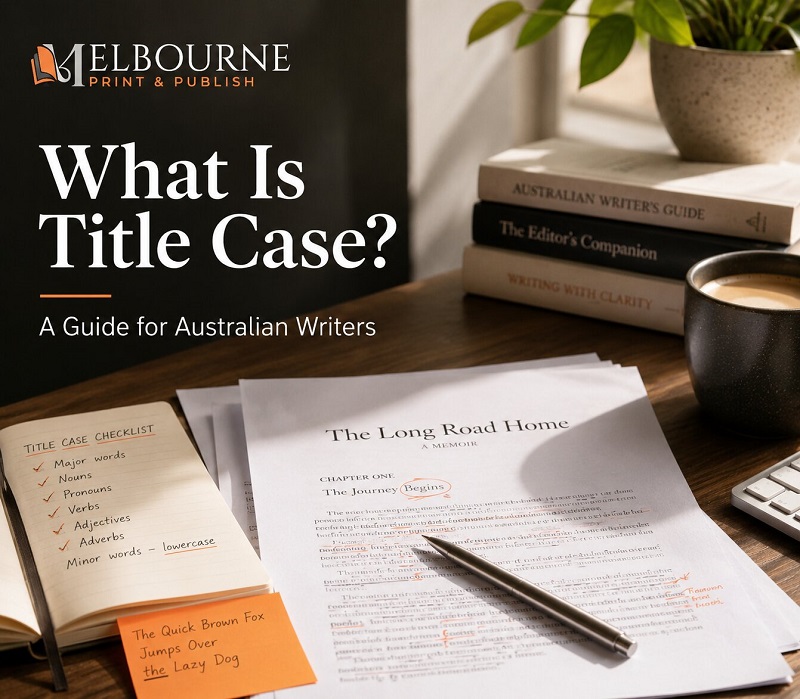
Learn what title case is, how it differs from sentence case, and how to capitalise titles correctly in Australian English, with rules and examples.....