Most people think a short story is just a small novel. It isn't. And that single misunderstanding is why so many promising stories end up reading like the first chapter of a book that never got written.
A short story is its own creature. It doesn't have room to wander. It can't afford three chapters of throat-clearing before the real thing starts. Every sentence has to pull its weight, and the good ones leave you sitting there a moment after you've finished, holding the feeling the writer handed you. That's the whole craft, really. One sharp moment that leaves a bruise.
Here's the thing nobody tells you when you're starting out: writing short fiction is harder than it looks precisely because it looks easy. Fewer words feels like less work. It's the opposite. When you've only got a few thousand words, there's nowhere to hide. A weak sentence in a novel disappears into the crowd. A weak sentence in a short story stands there in the spotlight, fully visible.
This guide is built to fix that. Whether you're figuring out how to write a short story for the very first time, or you've written a few and keep feeling like they fall flat at the end, we're going to walk through the entire thing properly. How to find an idea worth writing. How to build a character in a paragraph. How to structure a story that actually lands. How to cut without losing meaning. And how to get the finished piece in front of editors who might publish it. We'll keep it practical, and we'll keep it Australian, because the publishing landscape here in 2026 has its own quirks worth knowing.
Let's start where every story starts: with the idea.
Before we get into the doing, it's worth being clear about what we're actually making, because the form has edges and knowing them helps.
A short story is a complete work of fiction that you can read in a single sitting. That's the old definition, and it still holds up. Edgar Allan Poe, who thought harder about this form than almost anyone, argued that a short story should be readable in one go so the writer can control the reader's emotional experience from start to finish without interruption. You can't do that with a novel. Life gets in the way, the reader puts it down, picks it up three days later having lost the thread. A short story holds you in one grip the whole way through.
In practice, that means a tight focus. One central conflict. A small cast. A single dominant effect the whole piece is building towards. Where a novel might follow a character across years and continents, a short story usually catches them at a single turning point, the moment everything shifts.
It's a different muscle to novel writing, and if you've worked on longer fiction before, some of those instincts will actually work against you here. The sprawl that makes a novel rich makes a short story baggy. The trick is learning to do more with less, which is the recurring theme of everything that follows.
Every story starts as a small, ordinary thing. A memory. An overheard line. A "what if" that won't leave you alone. The mistake beginners make is waiting for lightning to strike, some grand, fully-formed idea to arrive complete. It rarely works like that. Ideas are built, not found.
Your most powerful stories often hide in the mundane. An overheard conversation on a tram. A childhood memory that still stings. A regret you've never told anyone. These aren't too small to matter, they're exactly the right size, because they already carry emotional charge. Your job is to mine them with a writer's eye for conflict and transformation.
Try this. List five emotionally charged moments from your own life, the joyful ones and the painful ones both. For each, ask a single question: what if this had gone differently? That's where the fiction begins. You're not writing a diary entry. You're taking the emotional truth of a real moment and amplifying its stakes until it becomes a story.
Here's how that works in practice. A writer once took a small memory, missing a bus, nothing dramatic, and turned it into a story about a woman who deliberately misses her flight to escape a controlling partner. The emotional core stayed the same, that flutter of a decision made in a split second. But the fiction raised the stakes until the moment mattered. That's the move. Real feeling, fictional pressure.
The writers who never run out of ideas aren't more imaginative than you. They've just trained themselves to see story everywhere. These three exercises build that habit:
The café game. Spend fifteen minutes somewhere public. Pick a stranger and notice three specific details, a nervous tic, an odd piece of jewellery, the way they hold their phone. Then invent the secret that explains them. You're practising the leap from observation to story.
Headline mining. Scan the news for the strange or the tragic, the small items, not the big ones. Write a hundred-word opening that imagines the human story behind the headline. The facts are the seed; the people are yours to build.
Object memory. Pick something in the room you're sitting in. Write its history in two hundred words, who owned it, what it witnessed, how it ended up with you. It's a quiet exercise, but it teaches you to find narrative in stillness.
Open-ended prompts can be paralysing. A good constraint, oddly, sets you free. As Stravinsky put it, the more constraints you impose, the more you free yourself, and writers have been borrowing that wisdom for decades. A word limit or a rule forces decisions, and decisions are where stories come from.
A few to get you moving: a character receives a package they ordered ten years ago, and you've got fifteen hundred words to tell us what's inside and why it matters now. Two strangers are trapped in a self-driving car that won't stop, and their conversation reveals a shared secret, in under two thousand words. A person discovers they can hear the thoughts of houseplants, and you've got eight hundred words to use that to explore loneliness. Notice how the constraint sharpens the idea rather than limiting it.
It would be strange to write a 2026 guide and pretend AI tools don't exist. Used well, they're a decent brainstorming partner, good for generating "what if" scenarios fast, breaking a block, throwing up combinations you wouldn't have reached on your own. Used badly, they produce exactly the clichéd, voiceless prose that gets stories rejected.
The line is simple. Use AI to generate twenty story seeds, then pick the one that genuinely surprises you, and write it yourself. The tool is the spark, never the fire. The human emotion, the specific voice, the lived detail, that has to come from you, because that's the part readers actually connect with. If you're curious about how craft concepts like point of view shape that voice, our piece on the omniscient point of view is worth a read.
In a novel, you've got room to let a character unfold slowly. In a short story, you might have a paragraph. So you stop describing characters and start revealing them, which is a completely different skill.
Hemingway had a theory about this. He called it the iceberg. The idea is that only a fraction of what you know about a character should appear on the page about one-eighth, with the other seven-eighths submerged. The reader senses that hidden weight even though it never surfaces, and that's what makes a character feel real rather than sketched. That weight underneath is what makes a character feel real rather than sketched.
So instead of telling us a character is heartbroken, you show her folding a jumper that still smells like him and placing it in a drawer she never opens. You haven't used the word "heartbroken" once, but we feel it more sharply than if you had. For every trait you want to convey, ask yourself: what action, gesture or line of dialogue would reveal this without stating it? Then cut the explanation. Trust the reader to do the arithmetic. They're better at it than you think.
You don't have room for full character sketches, so every detail you include has to work hard. Before you keep one, run it through three questions. Does it advance the plot or reveal something crucial? Can it pull double duty, a scar that hints at a backstory and foreshadows a fear? Is it specific and sensory, a chipped enamel mug rather than just "a cup"?
Specificity is everything here. "A cup" is invisible. "A chipped enamel mug with a faded netball logo" tells us about a life. Tools like Scrivener's character templates can help you keep track of only the details that matter, so you're not over-developing people the story doesn't have space for.
The fastest way to flatten a story is to write dialogue where people say exactly what they mean. Real people almost never do. Make every line a negotiation: the characters want something from each other, even if it's just to be acknowledged, and that wanting hums underneath the words. Subtext is your best friend.
Watch the difference. On the nose: "I'm angry because you forgot my birthday." Now with subtext: "Nice cake. Did you bake it yourself?" said while staring at a store-bought box. The second one tells you everything, the hurt, the passive-aggression, the history, without naming any of it. That's dialogue working.
Backstory is where short stories go to die. The temptation is to stop everything and explain how we got here. Don't. Alice Munro, who built whole worlds inside short fiction, described a story as being less like a road and more like a house, you go inside and stay a while. Her backstory lives in the walls, not in a lecture at the door.
A few ways to do it. The triggered memory: a smell or a song prompts a single-sentence flashback, then you're back. The casual mention: "Since the divorce, she'd stopped locking the door", that's an entire history in six words. The contradiction: a character acts against their stated belief, and we sense a hidden past without being told a thing. The rule of thumb: if you need more than two sentences of backstory, ask whether it's truly essential. Usually the reader's imagination fills the gap more powerfully than you could.
There's an old argument among writers about whether you should plan a story before writing it or discover it as you go. The honest answer is that both work, and the right one is whichever gets words on the page for you. But it helps to understand each properly.
If you like a map before you set out, outlining gives you one. You work out your protagonist's goal and the central conflict, then identify five to seven key scenes, the inciting incident, the rising action, the climax, the resolution. For each, write a one-line summary and note the emotional shift. Lay the scene cards out, physical index cards or digital, and you can spot pacing gaps before you've written a word of prose.
There are AI-assisted structure generators that will produce a rough beat sheet from your premise, which you can then pull apart and make your own. Useful as a starting scaffold, as long as you don't mistake the scaffold for the building.
Some writers can't outline. The moment they know the ending, the energy drains out of the thing. If that's you, start instead with a character in a situation that demands a decision, then write forward, following their choices, and let the structure emerge. George Saunders works this way, he talks about following the energy in a story and finding its shape through revision rather than planning. His story "The Semplica-Girl Diaries" began as a loose voice exercise and grew into a sharp critique of consumerism, with no outline in sight. The trick is trusting that your subconscious knows the shape even when you don't yet.
Most working writers land somewhere in the middle, and there's a neat minimal method for that, call it the five-point compass. You plot only five things: the opening image, the inciting incident, the midpoint shift, the climax, and the closing image. That's it. Enough direction to stop you getting lost, loose enough to leave room for discovery. Write the first draft following the compass loosely and allow yourself detours. Afterwards, check whether the five points still hold and adjust. It works especially well for stories under three thousand words. If you're moving towards longer work later, our guide on how to outline a novel scales these ideas up.
Structure is just the shape of the reader's emotional journey. Get it right and the story feels inevitable. Get it wrong and it sags, or rushes, or stops without landing. A few frameworks help.
You've probably met Freytag's pyramid, exposition, rising action, climax, falling action, resolution. It's a classic, and it's useful, but short stories tend to compress it brutally or invert it altogether. In a short story, the exposition is often a single paragraph, sometimes a single sentence. You don't have room for a gentle build. Get to the inciting incident by the end of the first page, and let the rise be steep and the fall almost nonexistent. Many of the best short stories end right on the emotional peak and trust you to walk down the other side yourself.
This is the most useful structural idea in all of short fiction, and it comes from Poe. He argued that a skilful writer decides, before writing a single word, on the one dominant effect they want the story to produce, and then bends every element towards it. Every incident, every detail, every line of dialogue serves that single feeling.
Think of it as a blueprint. Before you start, name the dominant emotion you're after, dread, wonder, heartbreak, quiet grief. Then, as you write, ask of every paragraph: is this serving the effect? If it isn't, it goes. This one discipline will do more for your stories than almost anything else, because it gives you a clear test for what belongs and what doesn't.
Start as close to the climax as you possibly can. Cut the warm-up. If your story is about a robbery, don't open with the planning, open with the hand on the doorknob. This is what writers mean by in medias res, beginning in the thick of the action. Shirley Jackson's "The Lottery" drops you straight into an ordinary village gathering, no preamble, and the very ordinariness is what builds the unease. The reader catches up as they go, and that catching-up is part of the pleasure.
Endings are where most short stories live or die, so it's worth knowing the main types. The twist ending recontextualises everything you've read, like the gut-punch reveal in Jackson's "The Lottery". But a twist only works if you've played fair, plant at least a few subtle clues that reward a reread, and never cheat the reader with information you hid from them. A good twist feels inevitable in hindsight, not cheap. Guy de Maupassant's "The Necklace" is the master class here; the clues were there all along.
Then there's the resonant ending, which doesn't tie up every thread but leaves you with a feeling, a question, an image that lingers. Alice Munro built a career on these, endings that leave questions open while still delivering deep emotional closure. Raymond Carver's "Cathedral" ends with a blind man guiding the narrator's hand to draw a cathedral, nothing is resolved on the plot level, and yet everything is. Aim for emotional closure, not necessarily plot closure. The two are different, and the first matters more.
If there's one skill that separates short fiction writers from novelists, it's compression. The ability to convey a great deal in very few words. It's also the skill most guides talk about and never actually demonstrate, so let's demonstrate it.
Read your story aloud. Any sentence you stumble over, or that sounds like throat-clearing, cut it. Then cut another ten per cent, because you're almost certainly still being too generous with yourself. Highlight every adverb and adjective, then remove half and let your nouns and verbs do the work, they're stronger than the modifiers propping them up. Hunt down "that", "just", "very" and "really" and delete them unless they're truly earning their keep. A free tool like the Hemingway Editor will flag your densest sentences and your adverb habit, which makes the fluff visible.
In a short story, a single well-chosen detail can do three jobs at once. A cracked window can show poverty, foreshadow a break-in, and quietly mirror a fractured relationship, all in one image. That's economy. You're not adding three sentences; you're choosing one detail that carries three meanings.
"The room was messy, with clothes on the floor and dishes in the sink. John was depressed."
After:"John stepped over the same pair of jeans he'd worn to the funeral, now stiff with dried mud, and ignored the sink full of plates that had grown a fine grey fur."
We never say "messy" or "depressed", but we feel both, and we get grief and the passage of time thrown in for free.
Let dialogue and action carry the backstory. As Chekhov famously put it, don't tell me the moon is shining, show me the glint of light on broken glass. If a character flinches at the sound of a doorbell, we know something happened, without being told what. Show a character avoiding a particular street, or going rigid at a certain name, and the reader infers an entire history. Charles Baxter's craft book The Art of Subtext is a brilliant deep dive if you want to push this further.
Compression is the engine room of short fiction, and it's also exactly the kind of polish a professional eye catches that you'll miss in your own work, which is part of why writers lean on professional editing before sending a story out.
Your first line and your last line carry more weight than any other sentences in the story. The first earns you the reader's attention; the last decides what they're left holding.
Your opening line is a promise. It should raise a question, create intrigue, or establish a voice so distinct the reader has to keep going. Skip the throat-clearing, the weather, the character waking up, and drop the reader straight into a situation "The morning after I killed my husband, I made pancakes", that gives you immediate conflict, dark humour, and a voice, all in eleven words. Or a quieter hook: "No one expected the lottery to end that way", which seeds foreshadowing and curiosity in a single breath.
By the end of your opening paragraph, the reader should know the protagonist's immediate situation, the story's tone, and the central tension, all without an info dump. It's a lot to carry, but it's doable if every element pulls its weight. A quick checklist for a strong first paragraph: a character introduced with a specific, concrete detail; a hint of trouble or desire; one sensory detail that grounds us in the scene; and a final sentence that makes the reader ask, "what happens next?"
Decide your ending type early, twist, resonant, circular, or ambiguous, and plant the seeds for it all the way through, so that when it arrives it feels like the only possible conclusion. A twist recontextualises the whole story. A resonant ending lands on a final image of connection or change, the way "Cathedral" does. A circular ending returns you to where you began but with new meaning, so the same image reads completely differently the second time.
And avoid the classic failures. Never end with "and then I woke up", and never reach for a deus ex machina, some convenient outside force that solves everything. The ending has to arise from the character's own choices, not from coincidence. Other endings to watch for: the story that simply stops without resolving, the fragment; the overly neat, moralising wrap-up; the twist built on information you hid from the reader; and the ending that betrays the tone you spent the whole story building. If your ending feels flat, the fix is usually at the beginning, because the seeds of a powerful ending are planted in the opening pages.
Nobody writes a great short story. They rewrite one. The first draft is just you telling yourself the story; revision is where you shape it for a reader. It works best in two passes, big to small.
After you finish a draft, put it away for at least a week. Distance is the only thing that lets you see your own work clearly. Then read it in one sitting and notice where your attention wanders, because those spots are your sagging middles, and the reader will wander there too. Then interrogate the structure: does the inciting incident hit within the first ten per cent of the story? Is there a clear midpoint shift or escalation? Does every scene change the character's situation or understanding, or are some just treading water? Is the climax the most intense moment, and does it actually resolve the central conflict? Scrivener's corkboard view is handy here, seeing your scenes laid out at a glance makes structural problems jump out.
Once the structure is solid, drop down to the sentence level. Run a grammar and spell check first, then go deeper. Hunt for repeated words and repeated sentence shapes, and vary them, because monotony at the sentence level dulls even good writing. ProWritingAid is useful for catching the glue-word habits and stylistic tics you've gone blind to. Then read the whole thing aloud one more time, marking every clunky line. If you stumble, your reader will too. Your ear catches what your eye glides over.
Short stories benefit enormously from fresh eyes, which is why writing groups and workshops are worth their weight. But the quality of feedback depends entirely on the quality of your questions. Don't ask "is it good?", you'll get a useless "yeah, I liked it." Ask specific, structural questions instead: "Does the ending feel earned?" "Where did you get bored?" "Did you believe the main character's choice at the climax?" Targeted questions get targeted answers, and those are the ones that actually improve the work. When you've taken a story as far as your own circle can take it, a professional book proofreading service gives it the final clean pass before it goes out.
You've written it, revised it, polished it. Now comes the part most writers find genuinely daunting: sending it out into the world. The good news is that the path is more navigable than it looks, especially once you understand how it works.
The short fiction market in 2026 is healthier and more varied than it's been in years. Most literary magazines now run electronic submissions, which has made the whole process faster and far less expensive than the days of posting manuscripts with a stamped return envelope. Response times still test your patience, though, waiting several months to hear back from a journal is completely normal, so submit and then get on with writing the next thing rather than refreshing your inbox.
Australia has a genuinely strong ecosystem for short fiction, with established literary journals, a healthy contest calendar, and organisations like Writers Victoria, Writing NSW and the Australian Writers' Centre offering resources, courses and community. If you're publishing locally, it's worth knowing how the Australian side of things works, our guide on how to self-publish a book in Australia covers the broader landscape.
Not every story fits every magazine, and the fastest route to rejection is ignoring that. Before you submit anywhere, do two things. First, check the publication's word count guidelines meticulously, exceeding them is the single quickest way to get an automatic no, no matter how good the writing. Second, read at least one issue. Every journal has an aesthetic, a sensibility, and you want to send your dread-soaked literary piece to the magazine that loves dread, not the one that runs gentle comic vignettes. Tools like Duotrope and The Submission Grinder help you find markets that fit and track where you've sent what.
Something genuinely new in the last few years: writers building direct readerships through serialised short fiction on platforms like Substack, bypassing the traditional gatekeepers entirely. It demands a different kind of pacing, every instalment has to end on a hook that pulls the reader to the next, much closer to how Andy Weir originally serialised The Martian for free on his own website, chapter by chapter, before it found a mass readership. It's not for everyone, but for writers who enjoy building a community as they go, it's a real and growing path.
When you do submit to a journal, keep your cover letter brief and professional. State the story's title and word count, give a one-sentence hook, and add a short bio if you have relevant credits. That's it. Don't summarise the story, the story speaks for itself, and don't apologise for being new or unpublished. Editors read hundreds of these; brevity and confidence stand out.
Here's the part nobody enjoys but everybody faces: rejection is simply part of the process, not a verdict on your worth as a writer. Some writers set themselves a target of a hundred rejections a year, because chasing rejections means you're submitting constantly, and constant submission is how stories eventually get accepted. When a story comes back, send it out again within a day or two, before doubt creeps in. And try reframing each rejection as data: for every one, jot down one thing you learned or one small revision you'll make. That turns a closed door into a tool.
Most short story problems come down to a handful of recurring mistakes. Knowing them in advance is half the battle.
Overstuffed casts. In a short story, every character has to earn their place. If you can remove someone without affecting the central conflict, remove them. Better still, combine roles, a story with a protagonist, a best friend, a mentor and a love interest can often merge the mentor and the love interest into one richer, more complicated character. Fewer people, deeper relationships, lower word count. Everyone wins.
Excessive backstory. If you catch yourself writing paragraphs of history, stop and ask what the reader absolutely needs to know right now, then give them that in a single vivid detail and move on. Trust the iceberg. As John Gardner put it, the reader is looking for an experience, not an explanation.
Sagging middles. The middle is where stories quietly die. Keep the momentum up by raising the stakes, introducing a complication, or revealing a secret, every scene should change the protagonist's situation somehow. If a scene leaves everything exactly where it was, it's a candidate for cutting.
Endings that fizzle. A flat ending almost always has its roots at the beginning, the seeds of a strong ending are planted in the opening pages. Make sure the protagonist's choice at the climax is the culmination of everything they've learned, or pointedly failed to learn, across the story. An earned ending feels like a payoff, not a stop.
One of the most practical things to know is which length category your story falls into, because it determines which markets you can submit to. Here's a quick reference for 2026.
| Category | Typical Word Count | Where It Tends to Live | Well-Known Examples |
|---|---|---|---|
| Microfiction | Under 100 words | Online journals, social platforms, micro-contests | Often called "drabbles" at exactly 100 words |
| Flash fiction | 100 – 1,000 words | SmokeLong Quarterly, Flash Fiction Online, contests | "Sticks" by George Saunders; "The Baby" by Donald Barthelme |
| Short story | 1,000 – 7,500 words | Literary journals (Meanjin, Overland, Griffith Review), anthologies | "The Lottery" by Shirley Jackson; "Cathedral" by Raymond Carver |
| Novelette | 7,500 – 17,500 words | Genre magazines (Asimov's, Clarkesworld), some contests | "The Metamorphosis" by Franz Kafka |
| Novella | 17,500 – 40,000 words | Small presses, standalone e-books, serialised platforms | "Of Mice and Men" by John Steinbeck |
A quick caveat worth keeping in mind: these boundaries shift a little depending on who's defining them, and individual contests often set their own limits, plenty of flash competitions cap at 500 or even 250 words. Always check the specific guidelines of wherever you're submitting rather than relying on the general ranges.
Before you call a story finished, run it through a quick three-part check. It's a faster way to find the weak spots than reading aimlessly and hoping something jumps out.
If any answer is no, your opening needs another pass.
If something drags, that's exactly where to apply your compression tools, cut ten per cent and watch the pace improve.
If the emotional impact isn't landing, name the dominant emotion you wanted, then reread and find where it's strongest. Your ending should sit right on that peak.
Writing a short story well is, at its heart, the art of doing more with less. Every section of this guide circles back to that one idea. Find an idea with genuine emotional charge. Build characters through implication rather than explanation. Structure the story around a single dominant effect. Compress without losing meaning. Open with a promise and close with something that lingers. Then revise, ruthlessly, until every word earns its place.
None of this comes all at once. The compression that feels impossible on your first story becomes instinct by your tenth. The endings that fizzle now will land later, once you've internalised the idea that emotional closure matters more than tidy resolution. The craft builds on itself, story by story, and the only way through it is to keep writing them.
If you reach the point where you've got a collection taking shape and you're thinking about putting it out into the world, that's where having a professional team in your corner makes a difference, from editing through to design and getting the finished book into readers' hands. But that's a later chapter. For now, the work is simpler and more important: write the story. Then write the next one.
A short story is a complete work of fiction you can read in a single sitting, usually somewhere between 1,000 and 7,500 words. Unlike a novel, it focuses on a single central conflict, a small cast, and one dominant emotional effect. It catches a character at a turning point rather than following them across a sprawling journey. The defining quality isn't just length, it's focus, everything in a short story bends towards a single moment and a single feeling.
Start as close to the central action as you possibly can, and open with a line that raises a question or establishes a strong voice. Skip the throat-clearing, the weather, the character waking up, and drop the reader straight into a situation that already has tension in it. By the end of your first paragraph, the reader should understand the protagonist's immediate situation, sense the tone, and feel a pull to keep reading. A good opening is a promise that something is about to matter.
Most short stories run between 1,000 and 7,500 words, which is the range most literary journals expect. Below that, you move into flash fiction (100 to 1,000 words) and microfiction (under 100). Above it, you're into novelette territory (7,500 to 17,500 words). The right length depends entirely on the story and, crucially, on where you want to submit it, so always check the specific word count guidelines of your target market before deciding.
For most writers it's compression, conveying depth, character and backstory in very few words without the piece feeling rushed or thin. The second hardest is usually the ending, crafting a close that feels both satisfying and inevitable rather than abrupt or contrived. Both come down to the same underlying skill: trusting the reader to infer what you don't spell out, and resisting the urge to over-explain.
Absolutely, though be ready to retrain some instincts. The expansiveness that makes a novel rich tends to make a short story baggy, so you'll need to learn to compress, to cut subplots, trim your cast, and build through implication rather than full explanation. Many novelists actually find that writing short fiction sharpens their longer work, because it forces a discipline around economy and focus that pays off everywhere.
Polish the story until it's genuinely ready, then research literary magazines and contests whose aesthetic matches your work, reading at least one issue of each before submitting. Follow their submission guidelines exactly, especially word counts, and send a brief, professional cover letter with the title, word count, a one-line hook, and a short bio. Use a tracking tool like Duotrope or The Submission Grinder to manage submissions, and expect rejections, they're a normal part of the process, not a sign to stop. Keep the story circulating, and keep writing new ones while you wait.
As a brainstorming or research aid, AI can be useful, generating "what if" scenarios, helping break through a block, suggesting angles you hadn't considered. The problem comes when it does the actual writing, because AI-generated prose tends to be generic and voiceless, exactly the qualities that get stories rejected. The emotional truth, the specific voice, and the lived detail that make a story connect have to come from you. Treat AI as a spark, never the fire.


Learn how to write a short story that lands. A practical 2026 guide to structure, compression and getting published, from Melbourne Print & Publish......
Learn what title case is, how it differs from sentence case, and how to capitalise titles correctly in Australian English, with rules and examples.....
.webp)
Practical methods, beat sheets and Aussie tips to outline a novel from logline to scene list. Build a working roadmap with Melbourne Print and Publish....
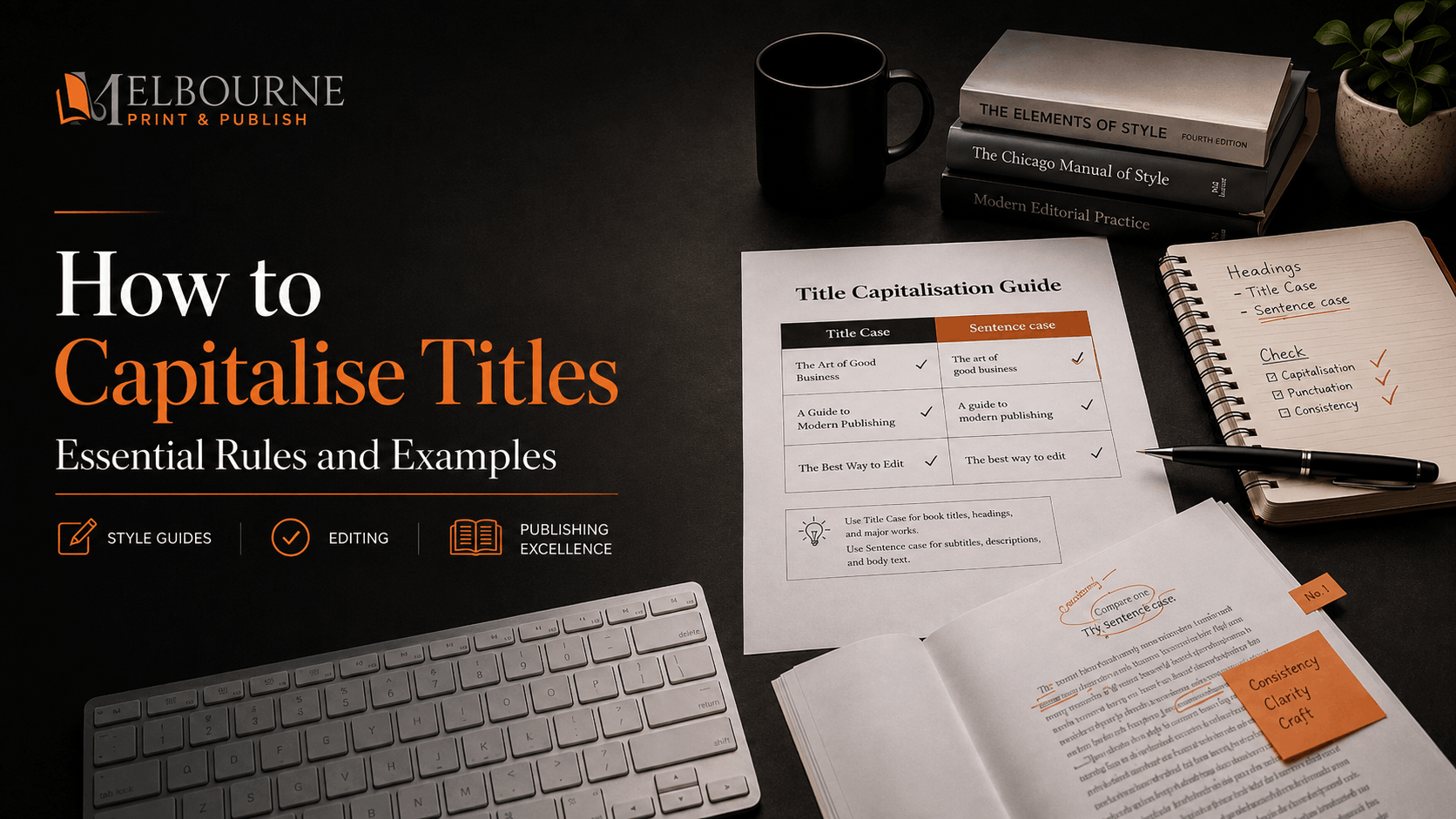
Which words do you capitalise in a title? Learn the AP, Chicago, APA and MLA rules, then format any heading with confidence using this clear, full guide.....